The
Uniforms of the San Diego Padres!
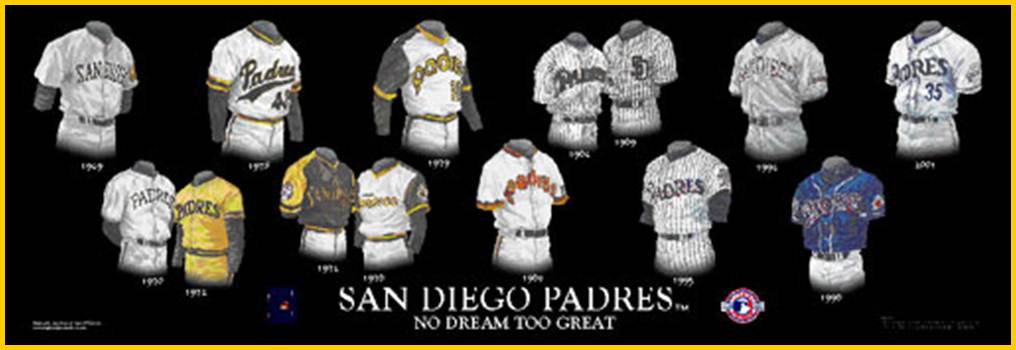
Titled “No
Dream Too Great” and licensed by Major League Baseball,
we present the uniforms history of the San Diego Padres.
Please note the print visuals shown here on our website simply cannot
do justice to the meticulous detail of the actual print. In addition, the year each uniform was first
introduced is inscribed underneath. Please also note the uniforms print you
receive may have been updated with additional uniforms than what is shown on
the print displayed above.
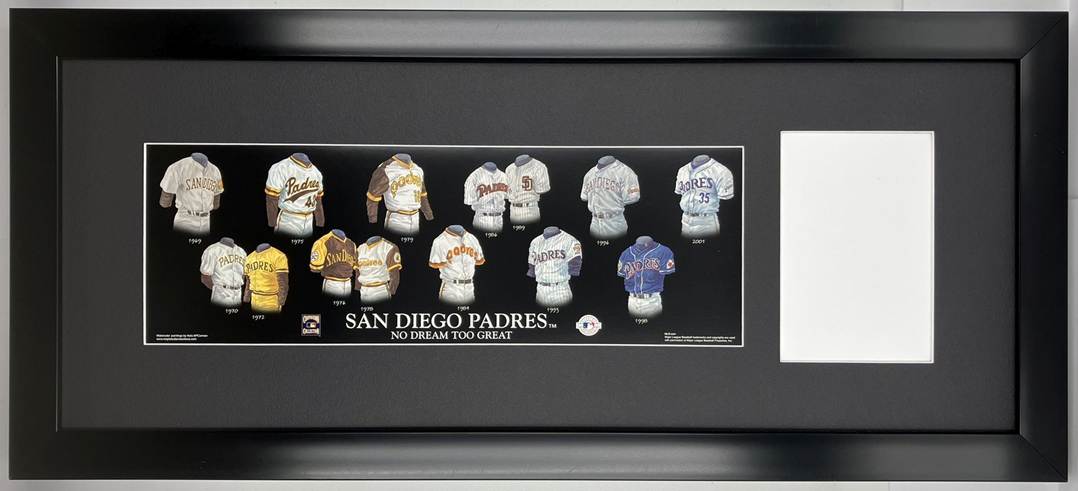
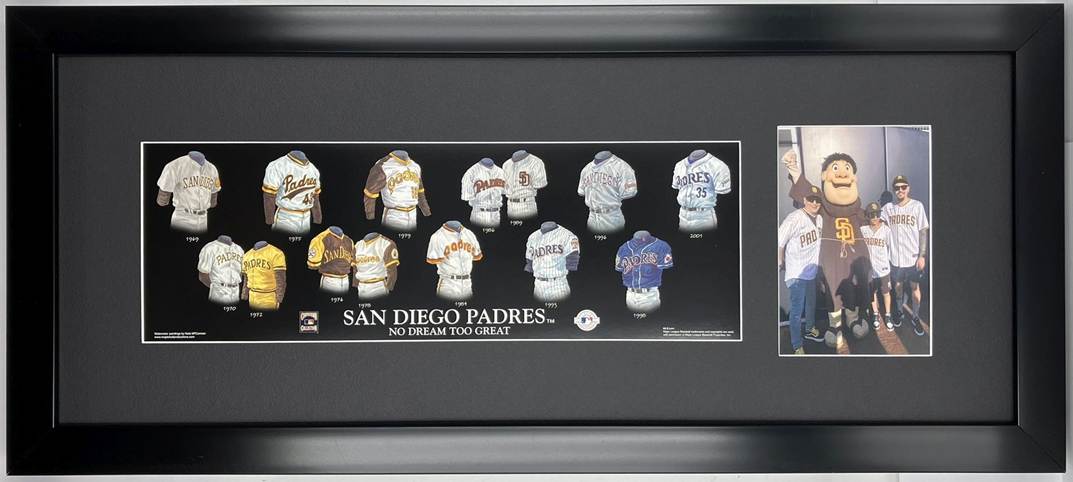
Framed with our classy multi-grooved black frame and matted in
black with a white accent mat, this is one striking artpiece. Measuring 12 ½ inches by 22 ½ inches with
glass covering, it comes fully assembled and ready to hang or lean. The cost is a welcoming $49 each and there is a one-time $6 discount shipping cost regardless of how many items
you order!
Below is an example of the framed artpiece,
which depicts the St. Louis Cardinals:
Please note all credit card orders and money orders are promptly
shipped within 24 to 72 hours. Personal
checks are shipped within 24 to 72 hours once the check has cleared.

Please call us toll-free at 1-800-786-3022 between
10am and 7pm (Eastern) Monday through
Friday,
and 3pm to 7pm Sunday with your Visa, MasterCard,
or Discover credit card order.
Or you can fill out and mail our Order Form with your
Check (made out to The Greatest-Scapes),
Money Order,
or Credit Card information to:
The
Greatest-Scapes•P.O.
Box 11548•Pittsburgh,
PA 15238.
Please click here for our Printable Order Form
You can also fax the Order Form anytime to
1-800-519-3884.
There
is a complete 30-day, moneyback guarantee including ALL shipping.

Got Questions?
Our frustration-free Customer
Service is available
between 10am and 7pm (Eastern) Monday through Friday,
and 3pm to 7pm Sunday at
1-800-786-3022.
Or you can E-mail us at greatestscapes@hotmail.com
Click
here to return to List
of Teams and Leagues

#1.
1969 The San Diego Padres joined the National
League in 1969 as an expansion team along with the Montreal Expos. They began
playing in a brand new facility, San Diego Stadium and through alterations, (in
name and construction) would remain their home to date. The first uniform we
see was worn on the road this season. It was a very simple design with “SAN
DIEGO” written in brown capital letters with yellow borders. The patch on the
left sleeve is in honor of the city of San Diego’s 200th
anniversary, 1769-1969.
The 52-110 team finished in last place in the National League West division,
(not unexpected for an expansion team) as did their expansion counterparts the
Expos in the East division. The fans in San Diego did witness a great baseball
moment this season when the San Francisco Giants came to town on September 22nd
where Willie Mays hit his 600th home run.
#2A.
1970 This is the first Padres home
uniform we see on the poster so far. It is still a simple design, with “PADRES”
written across the chest and some brown and yellow trim around the collar and
sleeves.
The Padres still finish in last place with a 63-99 record, but once again the
San Diego fans bare witness to another great baseball moment. On June 12th
the Pittsburgh Pirates pitcher Dock Ellis throws a no-hitter against the
Padres, winning the game 2-0. After the game he would claim he was on LSD at
the time. Just a sign of the times I guess
#2B.
1972 Here’s another sign of the times, as
this new home uniform for the Padres was all yellow, (perhaps another LSD
trip?) with brown letters and trim around the collar and sleeves. This is the
first we see of the “Sans-a-Belt”. The pants were called “Sans-a-Belt” because
the elasticized waistline eliminated the need for a belt. Quite the look.
Although the team hadn’t finished
out of last place yet, this season would see first baseman Nate Colbert finish
second to the Reds Johnny Bench for the home run title. Bench finished with 40
to Colbert’s 38. Colbert also hit 5 homeruns in a doubleheader against the
Braves to tie Stan Musical’s record set in 1954. Keen observers might note that
in 1972 the Padres went 59-95, only playing 154 games instead of the usual 162
– why? On March 30 1972, Marvin Miller, executive director of the Players'
Association, completes his canvass of players on the issue of a players’
strike. The vote comes in at 663 in favor of a strike, ten against, and two
abstentions. Thus on April 6 1972, for the first time in history, the
major-league season fails to open due to a general player strike. The strike,
announced April 1, will erase 86 games from the major league schedule. The end
of the baseball strike is announced on April 13 with an abbreviated schedule to
start two days later.
#3.
1975 Thank goodness the all yellow
uniforms only lasted three seasons and as we see on this home uniform they have
gone for a new look. The jersey is a double-knit style that most major league
teams succumbed to during the 70’s and early 80’s. It was a pullover style,
made of stretchy, synthetic material. The pants are still the “Sans-a-Belt”.
The “Padres” on the chest was new the season before and included a large
“swoosh” under the team name. This is also the first time on the poster we show
a jersey with the players number on the front, (it was first done in 1974).
Uniform numbers first made their appearance on the front of a uniform in 1952 -
the Brooklyn Dodgers were the first team to wear uniform numbers on the front
of their jersey. The Braves followed suit in 1953, and the Reds joined in
beginning in 1956. The 1916 Cleveland Indians actually wore a uniform number on
their sleeve, but it wasn’t until the ’52 Dodgers that the number made it to
the front.
In 1974 the Padres were about to
move to Washington, when the founder of McDonalds, Ray Kroc bought the team to
keep them in San Diego. For the first time in team history the Padres climb out
of the cellar and into fourth place in the NL West with a 71-91 record. Another
first as pitcher Randy Jones wins 20 games for the Padres and leads the league
in ERA at 2.24.
#4A.
1976 This season saw the Padres change
their road uniforms to a predominantly brown jersey with yellow on the sleeves
all the way up to the collar. The “SAN DIEGO” on the chest was also yellow and
brown trim was around each sleeve. The patch on the right sleeve is for the National
League’s Centennial year, 1876-1976.
Randy Jones out does last seasons performance with 22 wins to lead the league
and then was given the Cy Young award to top it all off. Also given recognition
was pitcher Butch Metzger who won the rookie of the year award, (shared with
the Reds pitcher Pat Zachry,) with an 11-4 record. Despite this, the team falls
to fifth place in the standings, going 73-89.
#4B.
1978 The Padres go for a new look this
season as we see on this home uniform. The “padres” on the chest is now all in
lower case with different style to it. A small “SAN DIEGO” is just above the
“pad” in “padres”. The sleeves are now brown, with a new patch on the left in
honor of hosting the All-Star game this year. On the patch we see for the first
time the image of the “Swinging Padre”. This character would be associated with
the team from now on.
On the field the Padres finish fourth in the west with an 84-78 record. Veteran
pitcher Gaylord Perry leads the league in wins with 21, and receives the Cy Young
award for his efforts. Reliever Rollie Fingers also leads the league in saves
with 37 for San Diego.
#5.
1979 The tinkering on the uniforms is now
year-to-year, as we see on this home jersey. The “padres” on the chest is much larger
and arched across the front. They have also removed the small “San Diego” above
the team name. Numbers make a return to the home jersey after a year off. This
would also be the last year of the “Sans-a-Belt”, (thank goodness!).
The team would finish the season
with a 68-93 record, while left fielder Dave Winfield leads the team and the
league with 118 RBI, while finishing third in home runs with 34. The next
season would see the Padres have three players with 50 or more stolen bases, a
first in the National League. Also in 1980, the team would change its stadium
name to Jack Murphy Stadium after the sports editor who campaigned for a team
in San Diego and got his wish.
#6.
1984 Both the pullover jersey and the
“Sans-a-Belt” are thankfully long gone. The “padres” on the front of this home
uniform is the same style as previous jerseys, but they have gone the way of
the Astros when it came to color. The team has mixed yellow, brown and orange
together to make quit the statement. These colors filled the lettering on the
front, trim around the collar and sleeves. The letters “RAK” on the left sleeve
are in memory of owner Ray Kroc who passed away before the season began.
The Padres win their first division title with a 92-70 record, while Tony Gwynn
wins his first of 8 batting championships with a .351 average and would face
the Cubs for the National League pennant. After being down 2 games to none and
on the brink of elimination, the Padres came back to win game three 7-1, then
took game four with a bottom of the 9th Steve Garvey two run home
run to win the game 7-5 and force a deciding game 5. The Cubs took an early 3-0
lead, only to have the Padres come back to take the game 6-3 for their first
pennant in franchise history. The ’84 fall classic featured the Padres vs. the
Tigers. Behind starting pitcher Jack Morris the powerful Tigers took the series
4 games to 1, with Morris winning both games he started.
#7A.
1986 The Padres have changed their look
once again, abandoning the color combination of yellow, brown and orange, while
keeping just the brown and orange. As we see on this home uniform, the “PADRES”
on the chest has been changed in style, while the main color is brown with
orange as its border. The team has added pinstripes for the first time, (this
was started by the Padres in 1985). On the left sleeve are the initials “RAK”
in memory of owner Ray Kroc who passed away in 1984. The team wore his initials
from ’84 to ’86.
The Padres finish fourth in the NL
West going 74-88, and Tony Gwynn leads the team once again with a .329 average
and leading the National League in hits with 211. Center fielder Kevin
McReynolds was a standout this season as well, leading the team in homers with
26 and RBI with 96.
#7B.
1989 On this road uniform we see the intertwined “SD” logo the team
adopted in ’85 for their jersey, which is similar to that of San Francisco’s
“SF”.
The Padres, with a season record of 89-73, finish second in the NL West to the
Giants, only three games back, while Tony Gwynn wins his fourth batting title
in six seasons with a .336 average. Reliever Mark Davis finishes atop the
league in saves with 44 and is named the Cy Young award winner, (he is the
third Padre to do so).
#8.
1993 The colors have been altered once
again, as we see on this home uniform. The “PADRES” on the front is now blue,
with orange trim around it. As well, the pinstripes are now blue as opposed to
brown. The patch on the left sleeve is for the 25th anniversary of
the ball club, 1969-1993.
The Padres finish dead last in the NL West with a 61-101 record, but set a team
record on August 24th by scoring the most runs in an inning with 13,
against the Cardinals.
#9.
1996 This is the first time we have seen
the changes the Padres made to their road uniform. They don’t have the pinstriped
uniforms while away from home, choosing a gray uni with “SAN DIEGO” on the
chest. The letters match the home jersey with blue and orange trim. The patch
on the left sleeve is a Padres logo patch, which the team wore on both home and
away uniforms.
The Padres season begins in a
foreign land. They played their first series against the Mets in Monterrey
Mexico. This was the first time major league games that counted in the
standings were played outside the U.S. or Canada. By seasons end they find themselves
in first place, one game ahead of the Dodgers with a record of 91-71. They take
on the Cardinals for the divisional series and lose three straight. Tony Gwynn
wins his third straight batting title and seventh over all with a .353 average,
while Ken Caminiti leads the team in home runs with 40 and RBI with 130,
becoming the first Padre to be named the National League MVP.
#10.
1998 This jersey is what is referred to
nowadays as a “3rd jersey”. A 3rd jersey is a concept
that became commonplace by the mid 90’s. Most 3rd jerseys are worn
occasionally at home as well as on the road, giving a team a third option as to
what uniform to wear. And of course, the addition of a third jersey adds to the
options fans can buy, thereby increasing apparel revenues and ultimately
benefiting the team. More recently, teams have begun adding 4th and
even 5th jerseys to their roster of uniform possibilities. This 3rd
jersey was all blue, (a much better look than their all yellow look of the
early 70’s) in color and had white trim that ran around the collar and down the
buttons, as well as on the sleeves. The patch on the left sleeve is the
“Swinging Padre” we last saw on the poster in 1978. The patch on the right
sleeve is a World Series patch that teams in the fall classic began wearing in
the 90’s.
A second trip to the World Series for the Padres was in the cards for this
season. They finished atop the NL West 9½ games ahead of the Giants going
98-64, and took on the Astros for the right to play for the pennant. They made
short work of Houston, winning 3 games to 1, and set their sites on the
defending World Series champion Atlanta Braves for the NL pennant. In an upset,
the Padres took the pennant 4 games to 2 and were on their way to their second
fall classic, (the first was in 1984, where they lost to the Detroit Tigers).
This time they face the Yankees and unfortunately the Padres aren’t much of a
match for them, losing four straight, giving the Yanks their 24th
championship.
#11.
2001 This home uniform for the Padres is
a real departure from some of the unis we’ve seen in the past. The orange is
totally gone and only blue and white remain, while numbers on the front have
made a comeback.
The Padres finish fourth in the NL
West, 13 games back of the Arizona Diamondbacks, with a 79-83 record. This
season would mark the last year for future Hall of Famer Tony Gwynn, who
retired with a career average of .338 and 3,141 hits.
***************************************
The San Diego Padres: “No Dream Too
Great”
The Greatest-Scapes is an
accredited business of the Better Business Bureau. We have been a member of the Better
Business Bureau since 1986—and we have an A+ rating. For more detailed information about The Greatest-Scapes, please click the BBB Logo at left. Thank you


800-786-3022
412-781-3022
E-mail: greatestscapes@hotmail.com
Click
here to return to List
of Teams and Leagues