Personalized!
A Powerful, Classy, and Creative way
to be joined at the hip with your favorite team
(And of course the uniforms print
will never go “out of Fashion” because a team’s uniforms are forever.)
You
can hang it, lean it, or let it lay flat.
Framed Version 3
Personalized Framed Evolution
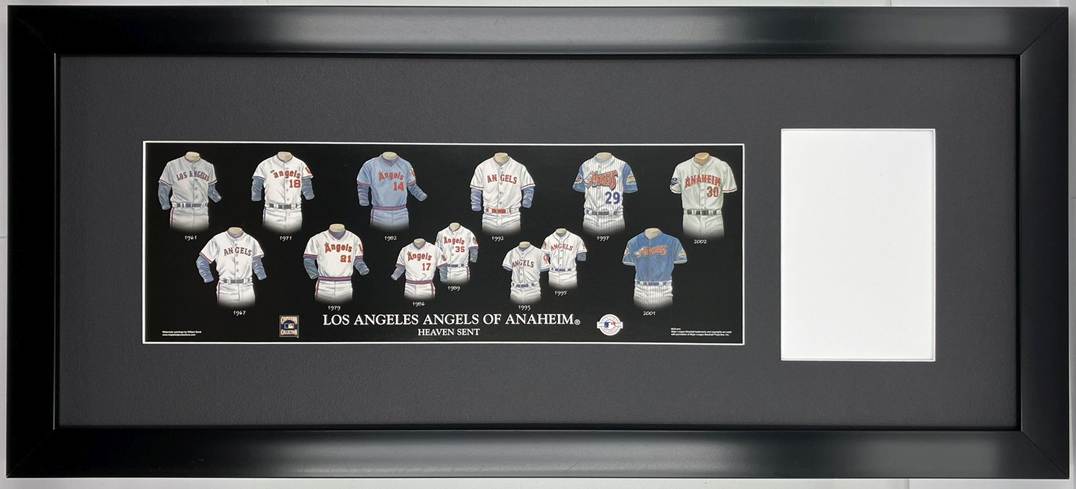
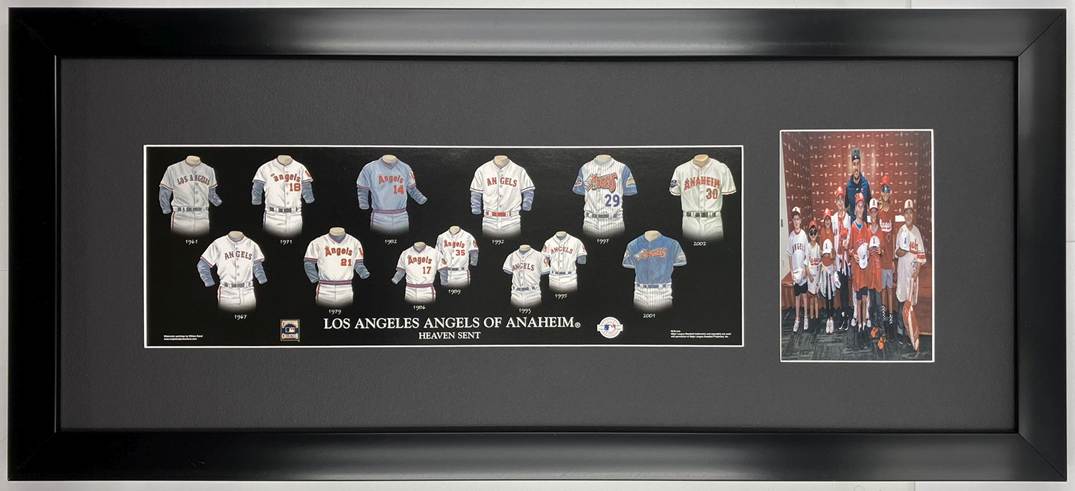
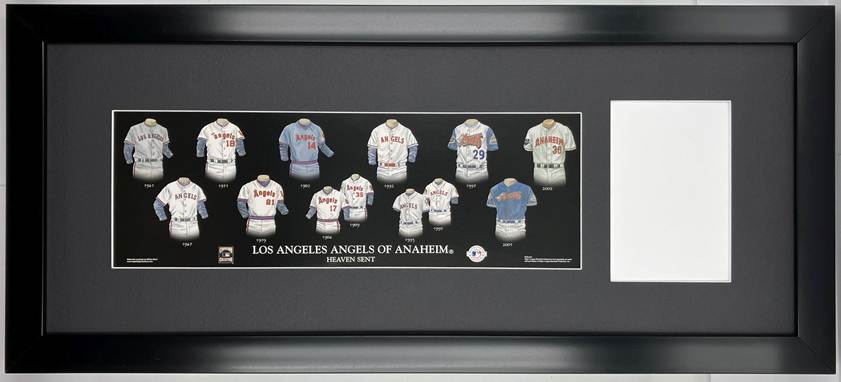
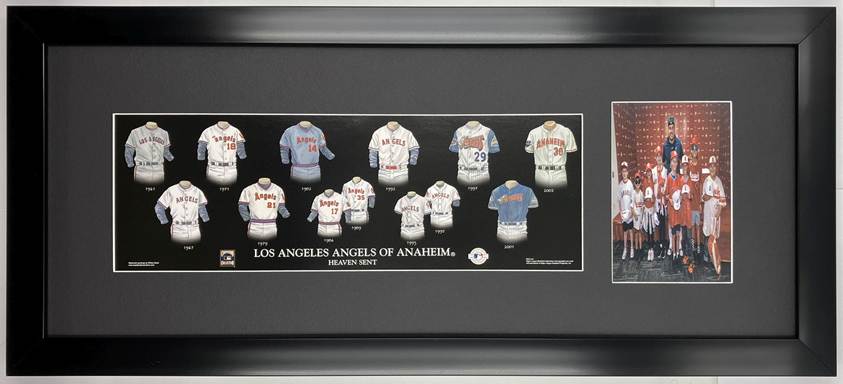
History Anaheim–L.A. Angels Uniform Print with Your Photo: Framed with our classic, smooth black frame
with glass cover, it measures 11 3/4 inches high x 26 1/4 inches long. The cost for this custom picture is only $79 and there is a one-time $6 discount shipping cost regardless of how many you
order!
Just
add your standard 4 inch x 6 inch photo – whether it’s you in your team jersey,
or team memorabilia or something very creative, your photo possibilities are
endless because you’re only limited by your imagination.
And
you can change your photo as many times as you like!
Here are the easy steps to add your photo:
1. Use a standard 6 inch x 4 inch
photo. Keep in mind the mat will slightly overlap the photo 1/8 inch
on all four sides.
2. Turn the framed picture on its
back and bend up all the flexible tabs used to secure the picture.
3. Remove the white backing.
4. Place your photo over the mat
opening. We have marked guide lines to help you position the photo
perfectly.
5. Secure your photo on all four
sides with strips of the quality Artist’s Tape we have provided.
6. Put back the white backing and
bend back a few of the flexible tabs.
7. Look at the picture to make
sure it looks great. Then bend back the rest of the flexible tabs to
secure your framed picture. You’re Done!
We will of course include a card listing the above
steps with your order. Keep in mind you can
change your
photo as many times as you like!
And if you ever need more tape, just email us and we’ll mail you more
tape at no charge. Our email is listed
on the card.
You can also view our
how-to-do video for our “Team Up With” personalized picture (This how-to-do
video applies to all our personalized framed pictures) here:
Or you can download
our how-to-do video.
Ordering Info:
Or
(You don’t pay Sales Tax when you order from our Shopping Page.)
Click here to return to List of Teams and
Leagues
***************************************
The Anaheim Angels:
“Heaven Sent”
The Greatest-Scapes is an
accredited business of the Better Business Bureau. We have been a member of the Better Business
Bureau since 1986—and we have an A+ rating.
For more detailed
information about The Greatest-Scapes, please click the BBB Logo at left.
Thank you

E-mail: greatestscapes@hotmail.com
Click here to return to List of Teams and
Leagues
***************************************
Here
is the history of the Angels’
Uniforms …
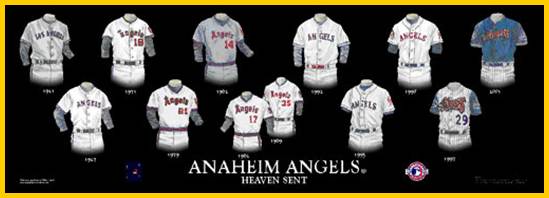
#1.
1961 The Anaheim Angels began as the Los
Angeles Angels in 1961 and were owned by legendary film star Gene Autry. The
name “Angels” was taken from the name of a team in the Pacific Coast League.
The Los Angeles Angels played their first
season, 1961, at Wrigley Field. But this was not the Wrigley Field in Chicago,
but rather the Angels’ minor league stadium in LA. Wrigley Field in Los Angeles
was a home run hitters haven, and the first year Angels had five players who
hit 20 or more homers: Leon Wagner with 28; Ken Hunt with 25; Lee Thomas with
24; Earl Averill with 21 and Steve Bilko with 20. The 1961 Angels finished in 8th
place in the 10 team American League with a respectable first year record of 70
and 91.
In their second season, 1962, the Angels moved
into Dodger Stadium which they shared with their National League counterparts
the Los Angeles Dodgers. They would share Dodger Stadium with the Dodgers until
1966 when they moved into the brand new Anaheim Stadium.
The Angels’ uniforms started out very simply,
as we see on this road uniform. The fancy capital letters on the front were
blue, with red borders. Red and blue trim went around the collar and sleeves,
while they had a stripe down each pant leg.
#2.
1967 This is a home uniform, and the style
and design are much the same as the original 1961 uniform. One significant
change is the fact that the team is now called the California Angels (the name
was changed for the 1965 season) and they have moved into a new home (all by
themselves), Anaheim Stadium in 1966. An unusual uniform fact is that the
Angels wore the team nickname “Angels” on both their home and away jerseys instead
of the more traditional nickname on the home uniform and city name on the road
uniform.
In 1967 the Angels had their third winning season in seven years with a 84-77
record. Their previous two winning seasons were 1962 and 1964, with the 1964
team featuring Cy Young winner Dean Chance. This 1967 season would also mark
the team’s first occasion to host an All-Star game. The 1967 All-Star game was
the longest All Star game ever played, going 15 innings, with the National
League winning a 2-1 pitchers’ dual. The Angels wouldn’t get to host the
All-Star game again until 1989.
#3.
1971 The
Angels made a change this season in the lettering on their jerseys – note that
the team name is entirely lower case and a halo has been added above the “a”.
The color of the letters has also changed from blue to red. On the left sleeve
there is a patch with the shape of California on it. At the top of the state of
California is a halo, and there is a star on the lower left signifying the city
of Anaheim. This is also the first time the Angels had player’s numbers on the
front of the jerseys.
Uniform numbers
first made their appearance on the front of a uniform in 1952 - the Brooklyn
Dodgers were the first team to wear uniform numbers on the front of their
jersey. The Braves followed suit in 1953, and the Reds joined in beginning in
1956. The 1916 Cleveland Indians actually wore a uniform number on their
sleeve, but it wasn’t until the ’52 Dodgers that the number made it to the
front.
The 1971 Angels finished 76-86 and in 4th
place in the 6 team AL West. Prior to the start of the 1972 season traded one
of their best and most popular players, Jim Fregosi, to the New York Mets for
four players. One of those players was Nolan Ryan, who would go on to play for
the Angels for 8 seasons and would lead the league in strikeouts seven times in
those eight seasons. He would also throw four of his 7 no-hitters for the
Angels, the first on May 15, 1973 against the Kansas City Royals, the second
two months later on July 15, 1973 against Tigers, the third being September 28,
1974 vs. the Minnesota Twins and the fourth on June 1st 1975 against
the Baltimore Orioles.
#4.
1979 This home jersey is of a double-knit style that most major league teams
succumbed to during the 70’s and early 80’s. It was a pullover style, made of
stretchy, synthetic material. The pants were called “Sans-a-Belt”’s because the
elasticized waistline eliminated the need for a belt. The 1970 Pirates were the
first double-knit - sans-a-belt team, and the Cards and Astros joined them in
1971. By 1975 two thirds of major league teams had joined in.
The Angels’ logo was changed in 1973 - the
lower case “a” was replaced by a capital ”A” with a halo on top. The patch of
the state of California, however, is still on the left sleeve of the 1979
jersey.
1979 would mark the Angels’ first appearance in post season play. They finished
atop the A.L. West standings with an 88 and 74 record, 3 games ahead of the
Royals. Left fielder Don Baylor led the way with a league leading 139 RBI, and
a team leading 36 home runs. Baylor would also be named the AL MVP after the
season. Nolan Ryan led the pitching staff with a 16 and 14 record and led the
league in strikeouts with 223 and shutouts with 5 (he tied for the lead with
two other pitchers).
The Angels took on the Baltimore Orioles for
the AL pennant in a best-of-five series. The Orioles took a two games to none
lead, but the Angels closed the gap by winning game three. But the glorious
1979 season came to an end as the Orioles triumphed in four to win the League
Championship series 3 games to 1.
#5.
1982 As
we see on this road uniform, there hasn’t been much change since the 1979
uniform. The Angels are still wearing the double knit pullover style jersey
with “Sans-a-Belt” pants.
Before the 1982 season the Angels owner Gene Autry (he was the first and only
owner) signed free agent outfielder Reggie Jackson from the Yankees. Jackson
makes an immediate impact by leading the league in home runs this season with
39, and the team finishes first in the AL West with a 93 and 69 record and head
to the post season for the second time in franchise history (the first time
being in 1979).
The Angels faced the Milwaukee Brewers for the
AL pennant in a best-of-five series and took a 2-0 lead, leaving them just one
win away from their first visit to the World Series.
But the Brewers came back to win games 3 and
4, tying the series at 2 apiece, setting up a fifth and final game in
Milwaukee. In a dramatic game, the Angels led 3-2 going into the bottom of the
7th when the Brewers struck for two runs to take a 4-3 lead. The
Angels would not be able to come back, allowing the Brewers to win the pennant,
becoming the first team to win a championship series after being down two games
to none.
#6A.
1986 Once
again the Angels uniform shows little change from 1982 it is still a double
knit pullover style jersey with “Sans-a-Belt” pants. One exception is the patch
on the left sleeve of this home jersey – this is a new patch. The patch shows a
baseball with the “A” logo on top of the state of California and a halo around
the top of the “A”.
1986 was a great season for the Angels as they finished 92-70, atop the AL West
for the third time (1979 and 1982 were their first two post-season
appearances). They faced off against the Red Sox for the pennant in a
best-of-seven series. Much like in 1982, the Angels took a commanding lead
(three games to one) and needed just one more win to take their first pennant
and make their first trip to the World Series.
Game 5 was in Anaheim, and it went to extra
innings before the Red Sox won in dramatic fashion in 11 innings. The game 5
loss seemed to demoralize the Angels, and Boston went on to win the next two
games in Boston in convincing fashion and thus advance to post-season play vs.
the Mets.
#6B.
1989 Finally the Angels have dropped the
double-knit pullover jersey and “Sans-a-Belt” pants, and have gone back to the
more traditional button front jersey with a real belt. The patch on the right
sleeve of this home uniform (although not too visible in this painting) is in
honor of the team hosting the 1989 All Star game for the second time (the first
was in 1967). The practice of the All-Star host team wearing an All-Star game
patch began a couple years before and continues to the present time. As for the
’89 midseason classic, the American League won 5-3.
The Angels finished the 1989 season in third place with a 91-71 record, 8 games
back of the first place A’s, but had a better record than the East division
winning Blue Jays who had an 89-73 record. Three of the AL’s top five pitchers
in terms of ERA were Angels: Chuck Finley with a 2.57 ERA; Bert Blyleven with a
2.73; and Kirk McCaskill with a 2.93 average. And the entire pitching staff led
the league in shutouts with 12.
#7.
1992 In the 1990’s, teams began the
practice of regularly wearing third uniforms. In this case the “third” uniform
was a “throwback” uniform, a tribute to the Angels’ uniforms of the 60’s. The 3rd jersey is a concept that became
commonplace by the mid 90’s. Most 3rd jerseys are worn occasionally
at home as well as on the road, giving a team a third option as to what uniform
to wear. And of course, the addition of a third jersey adds to the options fans
can buy, thereby increasing apparel revenues and ultimately benefiting the
team. More recently, teams have begun adding 4th and even 5th
jerseys to their roster of uniform possibilities.
The 1992 season would mark a couple of momentous occasions: Nolan Ryan’s number
30 was retired from the Angels’ line up (Ryan played for the Angels for 8
seasons and led the league in strikeouts seven times in those eight seasons. He
would also throw four of his 7 career no-hitters for the Angels, the first on
May 15, 1973 against the Kansas City Royals, the second two months later on
July 15, 1973 against Tigers, the third being September 28, 1974 vs. the
Minnesota Twins and the fourth on June 1st 1975 against the
Baltimore Orioles). The second momentous occasion this season was the fact that
George Brett of the Royals hit his 3000th career hit at Anaheim
Stadium, duplicating a feat accomplished in Anaheim by the Angels’ own Rod
Carew who stroked his 3000th hit in 1985).
#8.
1993 In
1993 the Angels adopted a new look, featuring an old fashioned style script
with blue letters on the front of their jerseys. The numbers on the front of
the jersey have been removed, while a new logo has been added to the left
sleeve. This new logo patch shows a fancier “A” with the halo on top and a “C”
for California interwoven with the “A”. Note also the blue trim that runs
around the collar, down the buttons and around the sleeves.
A young player stormed into baseball this season for the Angels was outfielder
Tim Salmon, who batted .283 while hitting 31 homers, 35 doubles and collecting
95 RBI. He was named the 1993 American League Rookie of the Year, the
first-ever Angel to win this award.
But the team itself could only put together 71
wins (vs 91 losses) and finished tied for 4th in the AL West.
#9.
1995 This
1995 Angels home uniform is similar to the 1993 uniform except for the addition
of a patch on the right sleeve. This new patch celebrates the Angels 35th
anniversary as a franchise, 1961 to 1995.
In a shortened season that started late due to the prolonged lockout, the
Angels finished with a 78-67 record, just one game back of the Seattle Mariners
for the American League West title and just one game back of the Yankees for
the Wild Card spot. The Angels were led by a trio of players at the plate: Tim
Salmon lead the way with a .330 average, 34 homers and 105 RBI; he was followed
by Jim Edmonds who hit .290 with 33 homers and 107 RBI; and close behind was
J.T. Snow with a .289 average, 24 homers and 102 RBI.
#10.
1997 1997
was a watershed year for the Angels’ franchise as the Walt Disney Corporation
bought the team and changed the team name to the Anaheim Angels. As we see on
this home uniform, the entire uniform has been revamped. Note the brand new
logo on the front of the jersey which features angel wings attached to an “A”.
Note also that pinstripes have been added for the first time in team history.
Note also the vest-style jersey, another first. The patch on the left sleeve is
a new “A” logo with “ANAHEIM” across the front and, of course, a halo at the
top.
The patch on the right sleeve commemorates the 50th anniversary of
Jackie Robinson breaking the color barrier of professional baseball. All teams
wore a patch in honor of Jackie Robinson and all he achieved, and all MLB teams
retired his number 42 - the first time in the history of the big four North
American sports (MLB, NFL, NBA, NHL) that a number has been universally
retired. (This has since been done one other time, by the NHL to honor the
retirement of Wayne Gretzky and his #99.)
The Angels finished a respectable 84-78, but 6
games back of the AL West leading Mariners. A couple highlights of the 1997
season: 1997 saw the beginning of interleague play, Eddie Murray graced the
field for game number three-thousand and Randy “The Big Unit” Johnson fanned
nineteen batters in the same game twice in the same season.
#11.
2001 The
Angels have just their second sub-500 season since 1997 as they finish with a
75-87 record, good for third in the four team AL West. Remarkably, the Angels
finish a whopping 41 games behind the Major League leading Seattle Mariners, a
squad which won a record 116 wins against only 46 losses.
This blue jersey is a “third jersey”. It is predominantly blue with “Angels”
across the chest and angel wings attached to the “A”. The patch on the left
sleeve is still the Angels logo, while on the right sleeve there is a patch for
the celebration of the American League’s 100th Anniversary. The
player’s numbers have been taken off the front of this third jersey, but still
remained on both the home and road jerseys.
2002 The
Angels have revamped their uniform yet again – they had a complete makeover
just 5 years earlier, in 1997. They have reverted back to a more traditional
uniform. Of note is the fact that the word “Anaheim” appears for the first time
on the front of the jersey (“Los Angeles” had previously appeared on the 1961
road jersey, while “California” never appeared). As noted in the write-up
accompanying the 1967 painting, for many years the Angels wore the team
nickname “Angels” on both their home and away jerseys instead of the more
traditional nickname on the home uniform and city name on the road uniform. Oh,
and one more thing … CONGRATULATIONS 2002 WORLD SERIES CHAMPIONS!!!