Personalized!
A Powerful, Classy, and Creative way
to be joined at the hip with your favorite team
(And of course the uniforms print
will never go “out of Fashion” because a team’s uniforms are forever.)
You
can hang it, lean it, or let it lay flat.
Framed Version 3
Personalized Framed Evolution
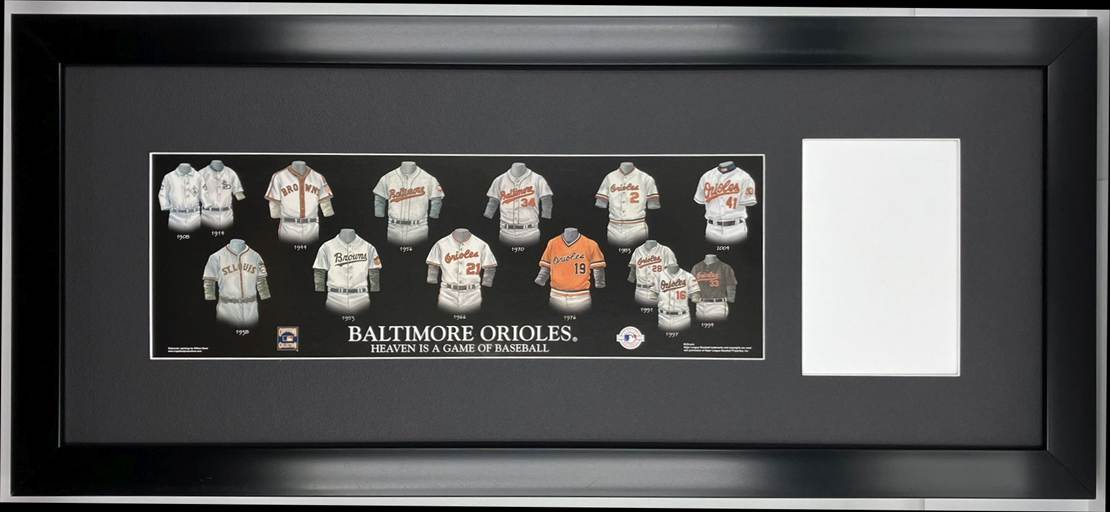
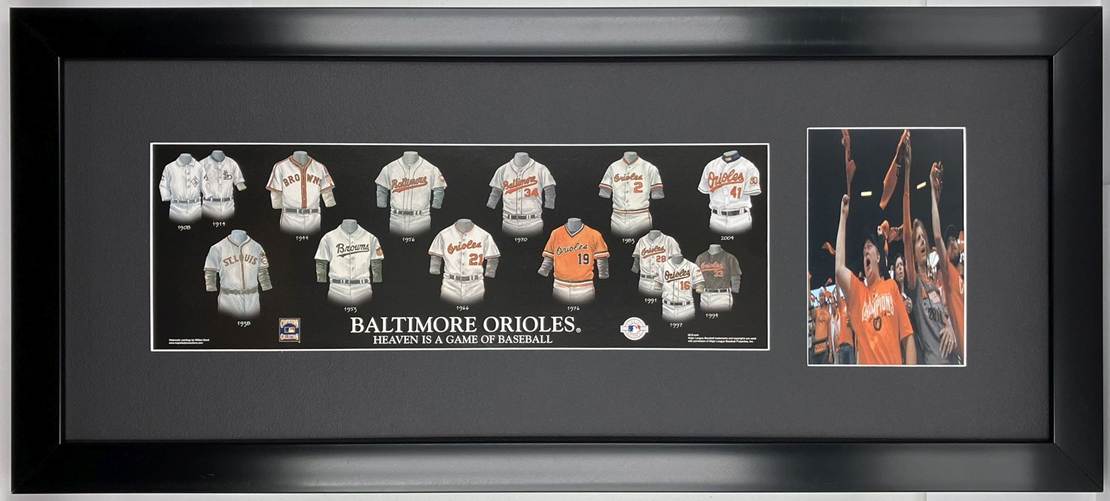
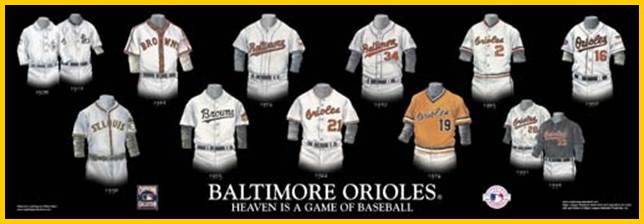
History Baltimore Orioles Uniform Print with Your Photo: Framed with our classic, smooth black frame
with glass cover, it measures 11 3/4 inches high x 26 1/4 inches long. The cost for this custom picture is only $79 and there is a one-time $6 discount shipping cost regardless of how many you
order!
Just
add your standard 4 inch x 6 inch photo – whether it’s you in your team jersey,
or team memorabilia or something very creative, your photo possibilities are
endless because you’re only limited by your imagination.
And
you can change your photo as many times as you like!
Here are the easy steps to add your photo:
1. Use a standard 6 inch x 4 inch
photo. Keep in mind the mat will slightly overlap the photo 1/8 inch
on all four sides.
2. Turn the framed picture on its
back and bend up all the flexible tabs used to secure the picture.
3. Remove the white backing.
4. Place your photo over the mat
opening. We have marked guide lines to help you position the photo
perfectly.
5. Secure your photo on all four
sides with strips of the quality Artist’s Tape we have provided.
6. Put back the white backing and
bend back a few of the flexible tabs.
7. Look at the picture to make
sure it looks great. Then bend back the rest of the flexible tabs to
secure your framed picture. You’re Done!
We will of course include a card listing the above
steps with your order. Keep in mind you can
change your
photo as many times as you like!
And if you ever need more tape, just email us and we’ll mail you more
tape at no charge. Our email is listed
on the card.
You can also view our
how-to-do video for our “Team Up With” personalized picture (This how-to-do
video applies to all our personalized framed pictures) here:
Or you can download
our how-to-do video.
Ordering Info:
Or
(You don’t pay Sales Tax when you order from our Shopping Page.)
Click here to return to List of Teams and
Leagues
***************************************
The Baltimore Orioles: “Heaven Is A
Game Of Baseball”
The Greatest-Scapes is an
accredited business of the Better Business Bureau. We have been a member of the Better Business
Bureau since 1986—and we have an A+ rating.
For more detailed
information about The Greatest-Scapes, please click the BBB Logo at left.
Thank you

E-mail: greatestscapes@hotmail.com
***************************************
Here then is the history of the Orioles’ Uniforms …
#1A.
1908 The Baltimore Orioles started out as the Milwaukee Brewers in 1901.
After only one season, and finishing dead last, the team was moved to St. Louis
where they were renamed the Browns. This jersey is a pullover style home
jersey. The logo is an S,T, and L inside a diamond, and the patch on the left
shoulder is a Fleur De Lis. If you notice, there is a center belt loop, which
was to secure the belt buckle off to one side. Players of this era usually wore
the belt buckle to one side so they could prevent injury when sliding into a
base.
#1B.
1914 This pullover style home jersey features a Cadet collar, rather
than the more “formal” collar of years past. In 1909 the Brown’s played in the
third edition of Sportsman’s Park, which they would call home until 1953. In
1920 the other St. Louis team, the Cardinals, moved into Sportsman’s Park as
well. In the time that the two teams shared diamonds, the Browns fans were
forced to watch their National League counterparts go to the World Series nine
times, six of which they won including one over the Browns in 1944, while the
Browns only made it to the World Series once (losing to the Cards!).
#2.
1938 The Browns road jersey, (typically, you can tell if a jersey is a
home uniform or road jersey by the color and the lettering. If it’s a darker
color, it’s most likely a road uniform, and if it says the team nickname as
opposed to the team city, it’s probably a home uniform) has a patch on the left
sleeve. This patch was commissioned by Donald L. Barnes, the owner of the
Browns (the team was actually known as the “American League Baseball Co.”) in
1937. The winning design belonged to Miss Helen Seevers of St. Louis. It is an
equestrian figure that stands atop a baseball that has “Browns” on it. The
shield is made up of stars and stripes, nine stripes to be exact, the same
number of players that take the field for each game.
#3.
1944 During this time period, while America is at war, the question is raised,
should able-bodied athletes of baseball be fighting for their country overseas?
The commissioner of Baseball and the President of the United States discuss the
game’s role in the war. Both agree that baseball is too important to the
people. It will boost the morale of the entire country, and take their minds
off of the war effort for a short time.
Wartime sleeve patches were worn
by all levels of professional baseball teams. The Health patch was only worn
for the 1942 season, part of a health and fitness awareness campaign. The Stars
and Stripes patch, as shown on the left sleeve of this home jersey, was worn
from 1943 to1945. It took World War II and the conscription of many star
players from other teams to give the Browns their first shot at the World
Series - against none other than their National League counterparts and Sportsman’s Park cohabitants - the
Cardinals. In a World Series that never left the same ballpark, the Browns went
up 2 games to 1, only to lose three straight, giving the Cards another
championship. This was the only pennant the Browns would ever claim.
#4.
The season began with a bang, with
Bobo Holloman pitching a no-hitter on May 6th in his first Major League start,
(this was his only season in the Majors) and ended with the team being sold to
Baltimore interests in September. This Browns home jersey is a prime example of
“no-frills”, with the exception of the “brownie” face patch on the left sleeve,
which was worn in the 1952-1953 seasons.
(To be honest we know very little about this patch, but we think it has
something to do with a contest that the owner at the time, Bill Veeck Jr.,
ran.I
#5.
1956 When the Browns moved to Baltimore in 1954, and the name was
changed to the Orioles, a team name long associated with the city of Baltimore.
In fact, the New York Yankees started out as the Baltimore Orioles in 1901
before moving to New York for the 1903 season - see the New York Yankees’
poster for a picture of the 1901 Baltimore Orioles jersey. 1956 was the first
year the Orioles replaced the team name on their road uniforms with
“Baltimore”.
Notice the zipper on this road
jersey. During the 40’s, 50’s and 60’s many teams used zippered jerseys instead
of the more traditional button front jerseys, while a handful of teams wore
them well into the 70’s and even the 80’s. The Reds, Yankees and A’s were the
only three pre-1977 major league teams which never wore zippers. The 1937 Cubs
were the first team to wear a zippered jersey, and as far we can tell the 1988
Phillies were the last to wear one.
The patch on the left sleeve of
this jersey is a caricature of an oriole with a ball cap on.
#6.
1966 With the strength of Frank Robinson’s Triple Crown feat during the
regular season, the Orioles took the American League Pennant, and stormed into
the World Series against the Los Angeles Dodgers. This would be the franchise’s
second trip to the World Series, (the first as the Browns, losing to the
Cardinals in 1944).
In a series that featured many
great pitchers and future hall-of-famers, the Orioles swept the Dodgers in four
straight. Los Angeles’ Sandy Koufax and Don Drysdale were no match for the
Orioles’ Jim Palmer, Dave McNally and Wally Bunker. The Dodgers scored only two
runs to Baltimore’s five in game one, and didn’t score another in the series.
In game two, 21-year-old Palmer allowed only 4 hits in a 6-0 win. Two days
later, game three starter Bunker, a fellow young gun, threw a three hit shutout
to win 1-0. After Frank Robinson’s homer in the fourth inning of game four,
Dave McNally shut out the bewildered Dodgers, giving the Orioles their first
World Series title, and Frank Robinson the series Most Valuable Player award.
Please note the uniform numbers on
the front of this uniform - this practice started in 1958 for both Baltimore’s
home and away uniforms. Uniform numbers first made their appearance on the
front of a uniform in 1952 - the Brooklyn Dodgers were the first team to wear
uniform numbers on the front of their jersey. The Braves followed suit in 1953,
and the Reds joined in beginning in 1956. The 1916 Cleveland Indians actually
wore a uniform number on their sleeve, but it wasn’t until the ’52 Dodgers that
the number made it to the front.
#7.
1970 After loosing the World Series in 1969 to the Cinderella New York
Mets, the Orioles made it back to the championship for the second year in a
row. They faced Cincinnati’s young “Big Red Machine” this year and defeated
them 4 games to 1. Brooks Robinson was the force behind the Orioles’ wins, batting
.429, with 2 home runs, and collecting 9 hits for the series. As well, his 4
hits in one game tied the single game record, and his 17 total bases set a new
one, making him the World Series MVP. Pitcher Dave McNally hit a grand slam,
the first ever by a pitcher in the World Series. The road jersey we feature has
very little change from the 1966 uniform.
It’s important to note that the
1969-71 Orioles have to be considered on of the best baseball teams in history
- they are one of only 4 teams in baseball history to win 100 games three years
in a row. In 1969 they went 109-53; in 1970 they went 108-54; and in 1971 they
went 101-57. The three other teams to win 100 games three years running were
the 1929-31 Philadelphia A’s, the 1942-44 Cardinals and the 1997-99 Braves.
#8.
1976 A 3rd uniform was worn by some Major League Baseball
teams, partly to break up the monotony of having just two to choose from, and
partly to sell more jerseys. The Orioles 3rd uniform is a double
knit style that most of the other teams succumbed to during the 70’s and early
80’s. It was a pullover style, made of synthetic material. The pants were
called “Sans-a-Belt”’s because the elastic material of the waistline eliminated
the need for a belt.
#9.
1983 The Orioles have almost dropped the double knit uniform of the
70’s, and have reverted back to the more classic style uniform with button-down
jersey - we say “almost” because for some reason they hung onto the double-knit
pants with the Sans-A-Belt waistline. In what was called the “I-95 Series”,
Baltimore faced Philadelphia for the World Series. Oriole slugger Eddie Murray
blasted 2 homers in game five and starting pitcher Scott McGregor, who took the
loss in game one, turned it around to pitch a shutout, giving Baltimore its
third World Series title (the others being in 1966 & 1970).
#10A.
1991 In a season where Oriole players and fans said farewell to their
beloved Memorial Stadium, the home of the Birds since 1954, their uniforms go
for a clean classic look, with no piping or stripes on this home uniform.
Beginning in 1989, the O’s re-introduced the “swoosh” under the
front-of-the-jersey lettering, a style used in the 50’s and 70’s. Cal Ripken
Jr. has a career year in 1991, hitting .323, with 34 home runs, 144 RBI,
winning the American League MVP, All-Star Game MVP, and Major League Player of
the Year honors.
#10B.
1994 In the year of the 125th anniversary of professional
baseball, (as shown on this third uniform, a pullover style with 2 buttons on
the top, and a commemorative patch on the right sleeve with the Major League
Baseball logo and “125th Anniversary” on it) there was no World
Series due to a disruption of play in August. This is the only time since 1904
that a World Series was not played.
When play finally resumes the next
season, one of the greatest records in baseball would fall, to an Oriole. On
September 6, 1995, Cal Ripken Jr. became baseball’s new “Iron Man”, by playing
in his 2131st consecutive game, overtaking Lou Gehrig’s old mark,
which was long thought to be one of sport’s unbreakable records.
#11.
1997 The Orioles went into the Division Series this year highly favored
against the Cleveland Indians. Unfortunately it was the Tribe that had the last
word, putting the Birds away in a tight six game series to take the A.L.
Pennant.
The lettering on the front of this
Orioles’ home uniform is predominantly black, while the jersey itself has black
piping around the neck and down the front. The patch on the right sleeve is to
commemorate the 50th anniversary of Jackie Robinson breaking the
color barrier in professional baseball, a patch which all Major League Baseball
teams wore in 1997. In addition, all MLB teams retired his number 42 - the
first time in the history of the big four North American sports (MLB, NFL, NBA,
NHL) that a number has been universally retired.
On the left sleeve there are 2
patches, the first is the classic Oriole that usually appears on the ball cap,
we’re fairly sure this is the first year that it appeared on the jersey. The
patch below it commemorates the 200th anniversary of the city of
Baltimore.