Personalized!
A Powerful, Classy, and Creative way
to be joined at the hip with your favorite team
(And of course the uniforms print
will never go “out of Fashion” because a team’s uniforms are forever.)
You
can hang it, lean it, or let it lay flat.
Framed Version 3
Personalized Framed Evolution
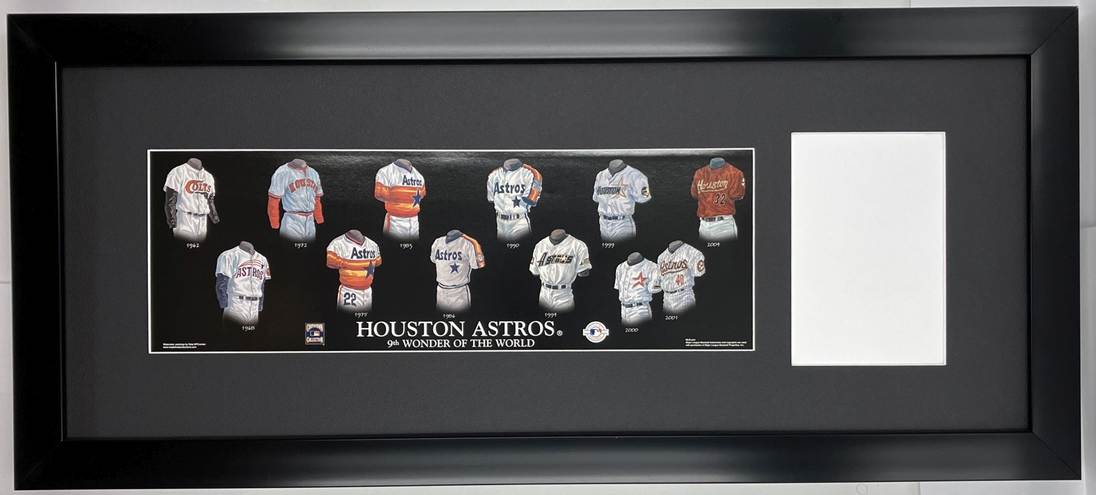
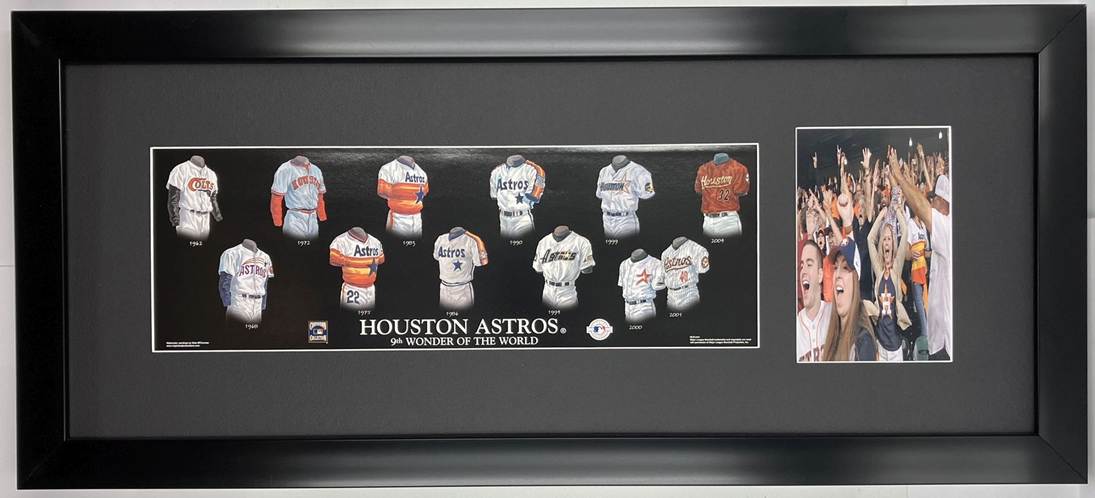
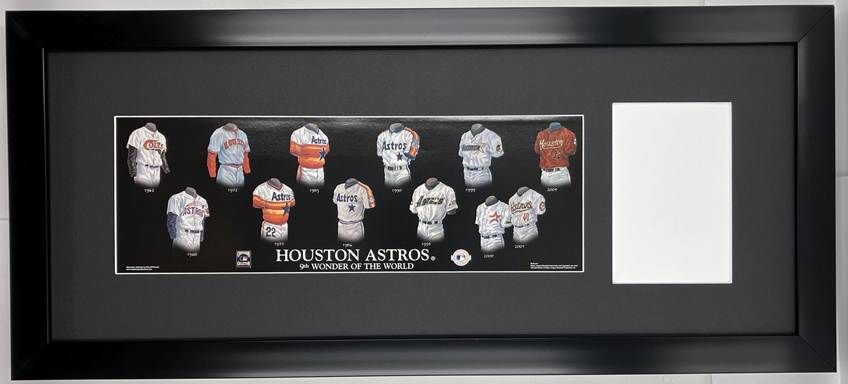
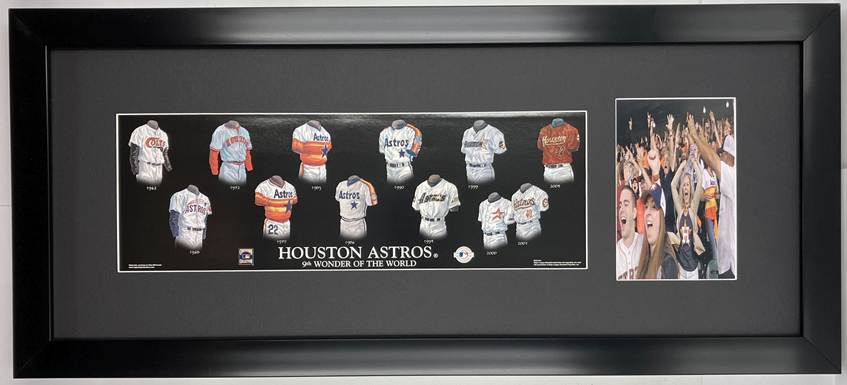
History Houston Astros Uniform Print with Your Photo: Framed with our classic, smooth black frame
with glass cover, it measures 11 3/4 inches high x 26 1/4 inches long. The cost for this custom picture is only $79 and there is a one-time $6 discount shipping cost regardless of how many you
order!
Just
add your standard 4 inch x 6 inch photo – whether it’s you in your team jersey,
or team memorabilia or something very creative, your photo possibilities are
endless because you’re only limited by your imagination.
And
you can change your photo as many times as you like!
Here are the easy steps to add your photo:
1. Use a standard 6 inch x 4 inch
photo. Keep in mind the mat will slightly overlap the photo 1/8 inch
on all four sides.
2. Turn the framed picture on its
back and bend up all the flexible tabs used to secure the picture.
3. Remove the white backing.
4. Place your photo over the mat
opening. We have marked guide lines to help you position the photo
perfectly.
5. Secure your photo on all four
sides with strips of the quality Artist’s Tape we have provided.
6. Put back the white backing and
bend back a few of the flexible tabs.
7. Look at the picture to make
sure it looks great. Then bend back the rest of the flexible tabs to
secure your framed picture. You’re Done!
We will of course include a card listing the above
steps with your order. Keep in mind you can
change your
photo as many times as you like!
And if you ever need more tape, just email us and we’ll mail you more
tape at no charge. Our email is listed
on the card.
You can also view our
how-to-do video for our “Team Up With” personalized picture (This how-to-do
video applies to all our personalized framed pictures) here:
Or you can download
our how-to-do video.
Ordering Info:
Or
(You don’t pay Sales Tax when you order from our Shopping Page.)
Click here to return to List of Teams and
Leagues
***************************************
The Houston Astros: “9th
Wonder Of The World”
The Greatest-Scapes is an
accredited business of the Better Business Bureau. We have been a member of the Better Business
Bureau since 1986—and we have an A+ rating.
For more detailed
information about The Greatest-Scapes, please click the BBB Logo at left.
Thank you

E-mail: greatestscapes@hotmail.com
Click here to return to List of Teams and
Leagues
Here is the history of the Astros’ Uniforms …
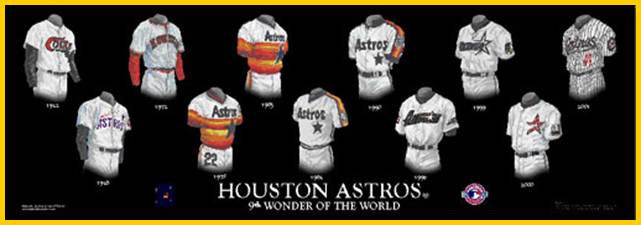
#1.
1962 The Houston Astros began life in
1962 as the Colt .45s, a reminder of the
famous six shooter gun. The Colts began playing in the temporarily
erected, 32,000 seat Colt Stadium (which was affectionately known as “Mosquito
Heaven”), where they would play for their first three seasons. The Colts
changed their name to the Astros in 1965 when they moved to the brand new
Astrodome. Colt Stadium, which is now part of the Astrodome parking lot, was
taken apart in the 70’s and sent to Mexico, where it was reassembled for the
Mexican League.
The 1962 Colts ended up 64-96 with
a group of players taken from an expansion pool, ahead of two other teams to end up in 8th
place in the new 10 team National League. The other two teams? The 59-105 Cubs
and the 40-120 New York Mets (the Mets were the other 1962 expansion team, and
with their 40-120 record set a modern day record for futility).
This is a Colts home uniform. Although perhaps not appropriate for today’s
politically correct times, the jersey featured a colt .45 six-shooter, with
“COLTS” scripted above it and the “C” of Colts wisping out of the barrel of the
gun. Attractive in is simple way, this was a very plain uniform, with no piping
or stripes, in fact not much color at all. That would change in a big way in
the 70’s!
#2.
1968 This home uniform was first introduced in 1965 when the team moved
from Colt Stadium to the 8th Wonder of The World, the Astrodome, and
changed their name to reflect their new home. The name Astrodome and Astros
reflected the importance of the country’s space program to Houston, and vice
versa.
This is still a very simple
uniform, with the team name in blue and orange-red outline, and a shooting star
symbolizing the “Lone Star State”. The patch on the left sleeve is a futuristic
looking insignia with the Astrodome in the middle, baseballs flying around it
like atoms and “ASTROS” written underneath. All in all, this uniform works!
A note about the Astrodome: The Astrodome was originally built with clear roof
panels and natural grass, but the outfielders had difficulty seeing fly balls,
and thus the roof panels were painted, which then killed the grass. The
solution was a green “carpet” made to look like real grass, and under-padding
to cushion the hard floor below. Thus “Astroturf” was born in 1966, a year
after the Astrodome opened.
In 1968, the Astros’ third season at the Astrodome, the team saw several
firsts. The longest 1-0 game in baseball history took place on April 15th
when the Astros beat the Mets in 24 innings. The Astrodome’s first and only
rain-out occurred on June 15th when a storm prevented the umpires
and the fans from getting to the game. Additionally, 1968 saw the Astros host the
first All Star game to be played indoors and on artificial turf, and it was the
first and only 1-0 All Star game. Unfortunately, 1968 was also the first time
in the franchise’s short history that they finished in last place (albeit with
a respectable 72-90 record). 1968 was also the first year that the Astros’
expansion twin, the Mets, finished ahead of them (the Mets finished a single
game better than the Astros at 73-89). Who could have predicted what 1969 had
in store for the Miracle Mets?
#3.
1972 The Astros 1972 home & away jerseys had something that many
teams had already used in the ‘40’s, ‘50’s and ‘60’s and then discarded - a
zipper.
During the 40’s, 50’s and 60’s
many teams used zippered jerseys instead of the more traditional button front
jerseys, while a handful of teams wore them well into the 70’s and even the
80’s. The Reds, Yankees and A’s were the only three pre-1977 major league teams
that never wore zippers. The 1937 Cubs were the first team to wear a zippered
jersey, and as far we can tell the 1988 Phillies were the last to wear one.
The Astros also got rid of their
belt and went for the “Sans-a-Belt” look which featured an elasticized
waistline, eliminating the need for a belt. The 1970 Pirates were the first
double-knit - sans-a-belt team, and the Cards and Astros joined them in 1971.
By 1975 two thirds of major league teams had succumbed.
“HOUSTON” was written in red block
letters across the front of this 1972 road jersey, while wide orange-red, white
and black trim was added to the collar and sleeves. The patch on the left
sleeve is the same as the last jersey we saw, with a color adjustment to suit
the away uniform. The Astros wore this style jersey from ’71 to ’74.
This season the Astros finished above .500 for the first time with their best
record ever - 84-69. This was good for second place in the NL West - the
Cincinnati Reds big red machine finished 10.5 games ahead in first. The Astros
led the league in runs scored with 708, and in only his third year in the
league, outfielder Cesar Cedeno led the league in doubles with 39 (shared with
the Phillies Willie Montanez) and led the Astros with a .320 batting average,
55 stolen bases and 8 triples.
#4.
1975 You know what they say, “No rain, no rainbow”. Well there wasn’t
any rain in the Astrodome, but there sure was a rainbow! The Astros introduce a
brand new uniform this season, the “rainbow jersey” – perhaps the most original
jersey in the history of major league baseball.
As we see on this home uniform, a
horizontal rainbow made up of several shades of orange has exploded onto the
scene. The jersey is made of a double-knit style that most major league teams
succumbed to during the 70’s and early 80’s. It was a pullover style, made of
stretchy, synthetic material. The pants still have the “Sans-a-Belt” waistband
that eliminated the need for a belt.
Above the rainbow is the team name
in a horizontal line, and on the left side of the rainbow is a large star, once
again symbolic of the “Lone Star State”. The #40 patch on the left sleeve is in
the memory of pitcher Don Wilson who died in the off-season after a 9 year
major league career, all with the Astros.
Note also the location of the
uniform number - on the upper right thigh of the pants. The uniform number on
the pants was a first for baseball when the Astros introduced it in 1972.
Even with the brand new bright uniforms, which should have distracted the
opposing teams thus creating more wins for the Astros, the Astros sputtered.
Houston would end up last in the National League (with a 64-97 record) for the
first time since 1968. On a good note, the team led the NL in triples, (you
have to look at the positive!) and a pitcher named JR Richard had blossomed
into a bona fide major league pitcher with a 12-10 record, a harbinger of things
to come.
For those of you who know the story, sorry. But for those who don’t, JR Richard
would go on to have 20-15, 18-12, 18-11, 18-13 and 10-4 seasons between 1976
and 1980 and he would start the 1980 all-star game, only to have his career
abruptly ended before the end of 1980 by a paralyzing stroke.
#5.
1983 The Astros wore three different uniforms this season – depicted
here is one of their home uniforms. It is pretty much the same as the 1975
jersey described earlier, but there are a few subtle differences. A white
border has been added to the star, and the orange has been taken away from the
collar, leaving only the blue. The rainbow pattern has also been subtly
changed, and the uniform number on the upper right thigh has disappeared. The
Astros would wear this uniform from 1983 to 1986.
After the excitement of the team’s first post-season play in 1980, where they
fell one win short of a National League Pennant when they lost to the Phillies
in extra innings in the 5th and final game of the NLCS, the Astros
were up and down for the next several years. In 1983 they finished third in the
West, but had some great individual achievements from players such as the 14-9
Nolan Ryan, who joined the team in ’80 and took control of the career strikeout
record from the great Walter Johnson this season, while Jose Cruz finished a
close third in the batting title with a .318 average (Bill Madlock was first
with a .323 average, and Lonnie Smith of the Cards hit .321).
#6.
1986 Don’t worry; the rainbow jersey was still around this year, we have
just chosen to show the Astros’ road uniform for this season. The rainbow
across the front has been moved to form a yoke from the collar down the
sleeves, while both the pant stripe and the elasticized belt have lost their bright
color, and are now simply blue and white.
The patch on the left sleeve
celebrates the Astros’ Silver Anniversary - 25 years of Astros baseball.
The bigger news is that the Astros finished first in the NL West in 1986 with a
96-66 record, their best finish ever. They faced the New York Mets for the NL
Pennant, but after leading the series 1-0 and tying the series 2-2, they lost
the 6th and deciding game in dramatic fashion in 16 innings to the
eventual World Series Champs. The Astros had a 3-0 lead from the bottom of the
first all the way to the top of the 9th, when the Mets tied it. The
score remained tied through the top of the 14th, when the Mets went
ahead by a run. But the Astros refused to say die, and tied it in the bottom of
the 14th. In the top of the 16th the Mets scored 3 runs,
but the Astros answered with two runs in the bottom of the 16th and
had two men on with two out when Jesse Orosco struck out Kevin Bass to end the
inning, the game and the series.
Manager Hal Lanier was honored
with the Manager of the Year award, a first in the teams franchise. Pitcher
Mike Scott won the teams’ first Cy Young Award with an 18-10 record, 306
strikeouts, 2.22 ERA and 5 shutouts (a record he shared with teammate Bob
Knepper). Also this season, the Astrodome played host to the All Star game for
the first time since 1968.
#7.
1990 A change in the uniform style was made in 1989, and we see it here
for the first time with this 1990 home jersey. Thank goodness the buttoned
front has made a comeback, and a normal leather belt has replaced the
elasticized “sans-a-belt”. The rainbow stripe down the sleeves has stayed, but
a blue border and blue cuffs have been added. The patch on the left sleeve
commemorates the 25th Anniversary of the Astrodome.
The team opened up the ‘90’s with very little to cheer about. Nolan Ryan signed
with Texas in 1989, and the 1990 Astros finished fourth in the NL West,
although pitcher Danny Darwin finished the season with a league leading 2.21
ERA and 11-4 record. This would mark the third time in the last five years that
an Astro pitcher would lead the National League in earned run average (Mike
Scott with a 2.22 in 1986, Nolan Ryan with a 2.76 in 1987, and Darwin with 2.21
in ’90).
#8.
1994 No more rainbow! The Astros have brand new uniforms this season as
we see on this home jersey. They have gone back to the simple sort of look they
once had in the ‘60’s, with a white background and no trim or piping on the
jersey at all.
For the 1994 season the team name
is blazoned across the front with a shooting star filling in the hole in the
“O”. The patch on the left sleeve celebrates the Astrodome with a simple “The
Original” statement beneath a sketch of the Dome. The 1995 jersey would have
the same patch with an additional banner underneath “The Original” that read
“’65 30th Anniversary ‘95”, celebrating the Astrodome’s 30th
anniversary.
The commemorative patch on the
right sleeve is in honor of the 125th year of professional baseball.
The patch has the Major League Baseball logo and “125th Anniversary”
on it, and celebrates the Cincinnati Red Stockings 1869 team that was the first
openly professional team and went 65-0 in a nationwide barnstorming season.
In this, the year of professional baseball’s 125th Anniversary,
there would be no World Series for the first time in 90 years, when a player
lockout in August 1994 put an end to the season. The Astros were sitting in
second place in the NL West with a 66-49 record, only a ½ game back of the Reds. In the shortened
season Jeff Bagwell wins the NL MVP award (the first for an Astro) with a .368
average and 39 homers, and he led the league with 116 RBI, 104 runs and 300
total bases. Oh what might have been… What a shame.
#9.
1999 The Astros make yet another change to their uniform. As we see on
this road jersey, the star has been lifted from being in the name of the team,
to the end of the “HOUSTON”. The patch on the left sleeve marks the last season
for the Astrodome, formerly the 8th wonder of the world, and says on
it, “35 Great Years 65-99”.
In the final season of the Astrodome, Houston finishes atop the National League
Central Division for the 3rd straight time, this time beating the
Reds by 1½ games. In what was considered to be an offensive team with the likes
of the “Killer B’s” Jeff Bagwell and Craig Biggio, pitching was the story of
the 1999 season. The Astros had two 20 game winners in 22-4 Mike Hampton (the
league leader) and Jose Lima 21-10 (second in the league to Hampton). The 1999
Astros also finished atop the N.L. in fewest home runs allowed with 128, fewest
walks allowed with 478, shutouts with 5 and strikeouts with 1,204. They played
the perennially powerful Atlanta Braves in the Divisional Series, but lost 3
games to 1.
#10.
2000 We see another change in the uniform. Gone from the jersey are both
the team name and the city name – leaving only a stylized star. This is a
beautifully simple jersey, as simple in design as the 1968 “shooting stars”
Astros jersey.
The patch on the left sleeve
signifies the inaugural season of their new retractable roofed home, Enron
Field, and says “Inaugural Season 2000”.
The Astros opened the season at their new home, Enron Field, and over three
million fans passed through the gates in 2000. The new ballpark features a
retractable roof to keep the Texas humidity and mosquitos out that were such a
problem in the Astros early days at Colt Stadium.
But on the field the 2000 Astros
can’t keep pace with their beautiful new home, and they finish a lackluster fourth
in the NL Central. On a positive note, the Astros reverted back to their heavy
hitting ways and led the league in home runs with 249.
#11.
2001 For the first time since the Colt .45’s became the Astros in 1965
there is no star on the front of the redesigned 2001 home jersey. The star
seemed to be a staple to the uniform, but is only represented this season on
the ball caps. The patch on the left sleeve celebrates 40 years of Colt
.45’s/Astros baseball.
The home uniform has gone from
plain white in 2000 to pinstripes in 2001, the first time the Astros have worn
pinstripes. As best we can tell, the first instance of pinstriped uniforms was
in 1907. The Boston Braves road uniform were made from a gray flannel with a
fine green pinstripe. Later that same year the Cubs had a new gray uniform with
fine pin striping made for the World Series - they wore it for the World Series
opener in Chicago and were later reprimanded by the league for not wearing a
white uniform at home. The Yankees, most often associated with pinstripe
uniforms, first wore a pinstriped uniform for one year at home in 1912 (the New
York Times wrote about their 1912 home opener “The Yankees presented a natty
appearance in their new uniforms of white with black pin stripes”), then every
year from 1915 to the present.
The 2001 Astros home jersey also
features a “swoosh” underlining the team name, another 2001 first. This style
was introduced to baseball by the 1932 Cubs, and has been worn by many teams
since then.
Finally, note that the uniform
number has been added to the front of the jersey itself, something we are
seeing again for the first time on an Astros jersey. Uniform numbers first made
their appearance on the front of a uniform in 1952 - the Brooklyn Dodgers were
the first team to wear uniform numbers on the front of their jersey. The Braves
followed suit in 1953, and the Reds joined in beginning in 1956. The 1916
Cleveland Indians actually wore a uniform number on their sleeve, but it wasn’t
until the ’52 Dodgers that the number made it to the front. And of course, we
can’t forget that the Astros themselves were the first team to wear a uniform
number on their pants when they did it in 1972.