Personalized!
A Powerful, Classy, and Creative way
to be joined at the hip with your favorite team
(And of course the uniforms print
will never go “out of Fashion” because a team’s uniforms are forever.)
You
can hang it, lean it, or let it lay flat.
Framed Version 3
Personalized Framed Evolution
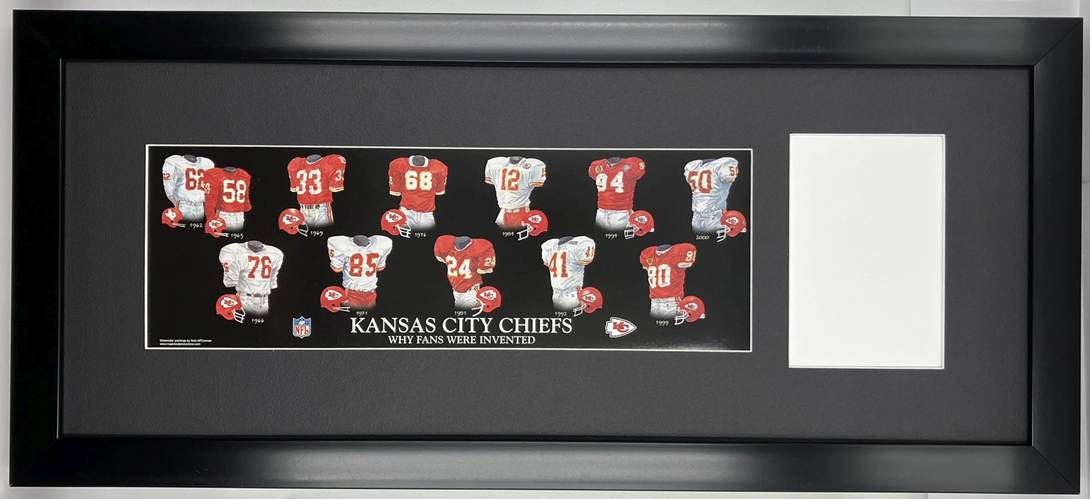
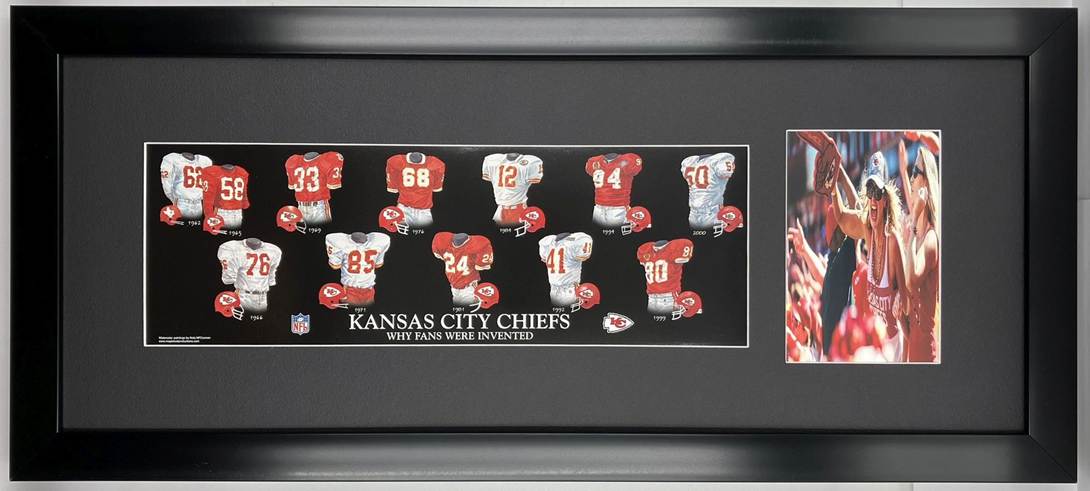
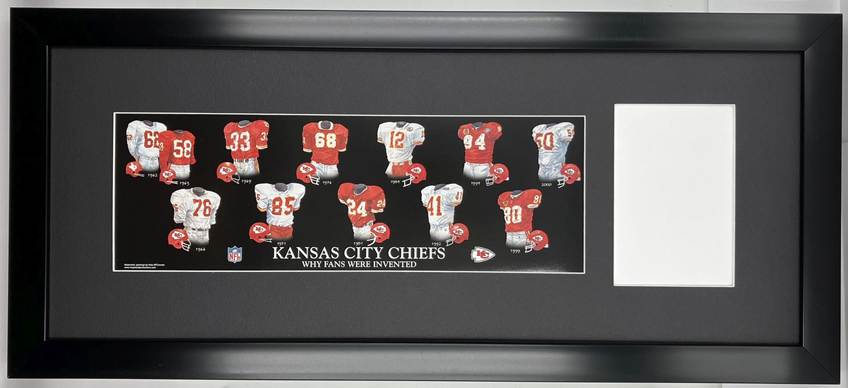
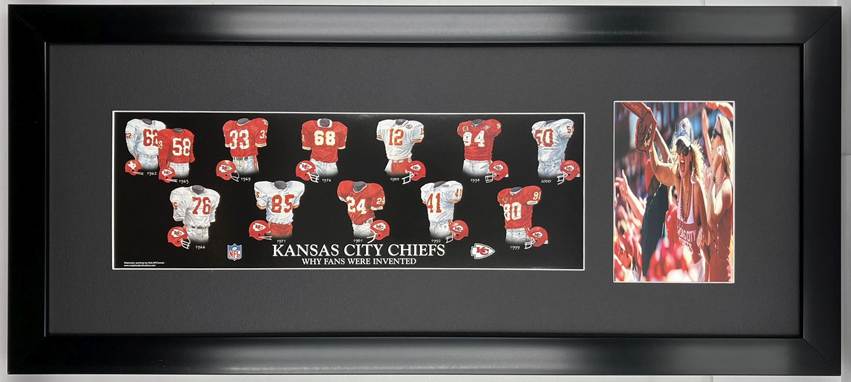
History Kansas City Chiefs Uniform Print with Your Photo: Framed with our classic, smooth black frame
with glass cover, it measures 11 3/4 inches high x 26 1/4 inches long. The cost for this custom picture is only $79 and there is a one-time $6 discount shipping cost regardless of how many you
order!
Just
add your standard 4 inch x 6 inch photo – whether it’s you in your team jersey,
or team memorabilia or something very creative, your photo possibilities are
endless because you’re only limited by your imagination.
And
you can change your photo as many times as you like!
Here are the easy steps to add your photo:
1. Use a standard 6 inch x 4 inch
photo. Keep in mind the mat will slightly overlap the photo 1/8 inch
on all four sides.
2. Turn the framed picture on its
back and bend up all the flexible tabs used to secure the picture.
3. Remove the white backing.
4. Place your photo over the mat
opening. We have marked guide lines to help you position the photo
perfectly.
5. Secure your photo on all four
sides with strips of the quality Artist’s Tape we have provided.
6. Put back the white backing and
bend back a few of the flexible tabs.
7. Look at the picture to make
sure it looks great. Then bend back the rest of the flexible tabs to
secure your framed picture. You’re Done!
We will of course include a card listing the above
steps with your order. Keep in mind you can
change your
photo as many times as you like!
And if you ever need more tape, just email us and we’ll mail you more
tape at no charge. Our email is listed
on the card.
You can also view our
how-to-do video for our “Team Up With” personalized picture (This how-to-do
video applies to all our personalized framed pictures) here:
Or you can download
our how-to-do video.
Ordering Info:
Or
(You don’t pay Sales Tax when you order from our Shopping Page.)
Click here to return to List of Teams and
Leagues
***************************************
The Kansas City Chiefs: “Why Fans
Were Invented”
The Greatest-Scapes is an
accredited business of the Better Business Bureau. We have been a member of the Better Business
Bureau since 1986—and we have an A+ rating.
For more detailed
information about The Greatest-Scapes, please click the BBB Logo at left.
Thank you

E-mail: greatestscapes@hotmail.com
Click here to return to List of Teams and
Leagues
***************************************
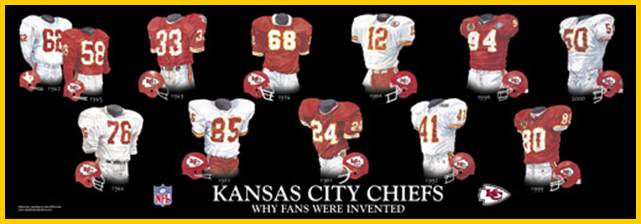
Here is the history of the Chiefs’ Uniforms …
#1A.
1962 The Kansas City Chiefs began life as the Dallas Texans when the AFL
began in 1960. In 1959, a 26-year-old Texan, frustrated in his attempts to gain
an NFL franchise, embarked on an alternate course that would drastically change
the face of pro-football. Lamar Hunt founded the American Football League and
served as its first president when eight new teams began play in 1960.
Joining the AFL as charter members
were the: New York Titans (now Jets); Dallas Texans (now Kansas City Chiefs);
Denver Broncos; Los Angeles Chargers (now San Diego Chargers); Houston Oilers
(now Tennessee Titans); Boston Patriots (now New England Patriots); Buffalo
Bills; and the Oakland Raiders.
The Texans finished the regular
season with an 11-3 record, and after only two seasons in the league, won the
AFL Championship. In the final game, played on December 23rd in
Houston at Jeppesen Stadium before 37,981 people, the Texans won 20-17 in
double overtime.
The Chiefs had a strong offence, and
it was proven when Abner Haynes became the first player to rush 1,049 yards.
This white away jersey with the
red numbers outlined in yellow on the chest and arms matches the red helmet
which outlines Texas. Notice the stripes of red and orange on the side of the
legs.
#1B.
1963 After three successful seasons in Dallas, owner Lamar Hunt decided
that the team would be better ff if he moved them to Kansas City. Therefore
they moved, and through a fan contest, the name Chiefs was selected as the team
name. In the teams first year of play in KC, they went 5-7-2 and were led by QB
Len Dawson and R Chris Burford.
This red home jersey is a
duplicate of the previous years jersey. Note that the helmet has changed.
Instead of the map of Texas, there is now the Chiefs logo on the side: an
arrowhead and “KC” on the side of the helmet. The logo is still used today.
#2.
1966 The period of time between 1966 and 1969 warrants a bit of
explanation. The 8 team AFL began in 1960 as a rival league to the NFL - both
leagues competed head to head for players, fans and TV revenue. And thus it was
for 5 years - two separate leagues, two separate champions (although few people
would have honestly believed that the AFL champion could have beaten the NFL
champs). Then in 1965 the two leagues agreed to merge. It was decided that
beginning in 1970 there would be only one league, the NFL, and that between
1966 and 1969 the AFL Champion would play the NFL Champion for the “World
Championship”. It was only after the first World Championship had been played
in 1966 that the name “Super Bowl” came into being.
The Chiefs were led by QB Len
Dawson who passed 2527 yards and 26 td’s, and 23 sacks.
RB Mike Garrett, in his rookie
season, averaged 5.4 yards per carry, and in the following season he would rush
for 1,000 yards.
In 1966, the Chiefs finished first in the AFL’s Western Division with an 11-2-1
record and would go on to crush the Buffalo Bills in the Championship game 31-7
in front of the Buffalo crowd. This then set the stage for the first ever
meeting between the AFL Champions (in this case the Chiefs) and the NFL Champs
(in this case the powerful Packers) in a “World Championship”.
The game was played in Los Angeles
at the Memorial Coliseum on January 15th, 1967. Suffice to say that
the Packers came out on top 35 -10. (Even though the game was played in 1967,
most football historians refer to this as the 1966 Super Bowl because it was
the culmination of the 1966 season.) The NFL superiority was on display again
in 1967, when the NFL’s Packers pounded the AFL’s Raiders 33-14. Then came 1968
and the stunning upset - the AFL’s NY Jets shocked the football world by
beating the NFL’s heavily favored Baltimore Colts 16-7.
This white away jersey has only
one change – the sleeves. Note the
changes on the helmet’s mask. The helmet also has the arrowhead and “KC” on it
that the team would keep until the present day. We have also included the neck
guard which many players wore for further protection.
#3.
1969 The period of time between 1966 and 1969 warrants a bit of
explanation. The 8 team AFL began in 1960 as a rival league to the NFL - both
leagues competed head to head for players, fans and TV revenue. And thus it was
for 5 years - two separate leagues, two separate champions (although few people
would have honestly believed that the AFL champion could have beaten the NFL
champs). Then in 1965 the two leagues agreed to merge. It was decided that
beginning in 1970 there would be only one league, the NFL, and that between
1966 and 1969 the AFL Champion would play the NFL Champion for the “World
Championship”. It was only after the first World Championship had been played
in 1966 that the name “Super Bowl” came into being.
As mentioned earlier, the 1966 season
saw the AFL Chiefs fall 35-10 to the NFL’s Packers. The NFL superiority was on
display again in 1967, when the Packers pounded the AFL’s Raiders 33-14. Then
came 1968 and the stunning upset - the AFL’s NY Jets shocked the football world
by beating the NFL’s heavily favored Baltimore Colts 16-7.
Thus the stage was set for the
Super Bowl IV, the last meeting between the AFL and NFL Champions. Although the
Chiefs finished the 1969 season in second place behind the Oakland Raiders in
the AFL Western Division with an 11-3 record, they would go on a great playoff
run. They took on the Jets first, beating them 13-6 in New York. Next up were
the Raiders in Oakland for the AFL Championship. The Chiefs came out on top
17-7 and headed to their second Super Bowl (their first being the 1966 loss to
the Packers).
Kansas City traveled to New
Orleans on January 11th to play the Minnesota Vikings for Super Bowl
IV and won their first championship 23-7 in front of 80,562 fans. MVP of the game was Chief’s QB Len Dawson.
This red jersey includes the
addition of white and yellow stripes on the sleeves. The patch on the left
shoulder celebrates the AFL’s 10th Anniversary, and features an “A”
over an eagle that is holding on to a football.
Note the mask is changed on the helmet, as well as the arrowhead and
“KC” which, the team still uses today.
#4.
1971 The Chiefs enjoyed success this
season as they finished a top the AFC’s Western Division with a 10-3 record.
They were led by quarterback Len Dawson who threw for over 2500 yards, and on
the other end had Otis Taylor catching his passes for over 1100 yards.
The team went on to play the
Dolphins in the AFC Divisional Playoffs, but fell to Miami 27-24 in double
overtime. Place-kicker Jan Stenerud would remember this game not as a great
playoff game, but as a “personal disaster”, as he missed a 32-yard field-goal
attempt in the closing minute of the game. This would be the Chief’s last game
ever played at Municipal Stadium.
This white jersey has red numbers on the front and sleeves. It also has red and yellow stripes on the
sleeves. This is the first time we see red pants on the poster. The helmet has
the arrowhead and “KC” on it that the team would keep until the present day. Note
the change of the mask.
#5.
1976 The Chief’s fell on hard times in
the ’70’s and this season was no different. With the firing of their long-time
head coach Hank Stram two years prior with a 5-9 record, they finished the
following year second from the bottom with a 5-9 record under the eye of Paul
Wiggin. For the third year in a row, they finished the 1976 season with a 5-9
record, and wouldn’t make it back to the playoffs until the mid ‘80’s.
Although the team had a tough
year, there were still a few players who shone. QB Mike Livingston passed 2683
yards and 12 td’s, with 38 sacks.
This red home jersey has white numbers and yellow outlines, which are also on
the sleeves. Note the change of the stripes on the sleeves from red and yellow
to white and yellow. The helmet has the
arrowhead and “KC” on it that the team would keep until the present day. Also
note the change to the mask. More bars have been added for more protection. As
well, we have added a neck guard, as most teams start to use them in this year.
#6.
1981 Although the Chiefs had a winning
record this season going 9-7, they wouldn’t make it into the playoffs. This
marked their first winning season since 1973 when they went 7-5. Future Hall of
Fame Head Coach Marv Levy would end his five-year tenure with the Chiefs at the
end of the following season.
The chief’s were led by QB Bill
Kenney, who passed 1983 yards and 9td’s.
Note the change on this red
jersey, as the sleeves become shorter. The helmet has the arrowhead and “KC” on
it that the team would keep until the present day. Note also the change of the
mask.
#7.
1984 Once again the Chiefs fell on hard
times with a losing record for the two previous seasons and would finish this
year at 8-8. The teams punter Jim Arnold was kept busy this season with 98
punts for 4397 yards, tops in the NFL.
Note the colours of the stripes on
the sleeves have been changed back of the red and yellow. Also, note the patch
on the left shoulder of this white jersey. The patch celebrates the AFL’s
silver anniversary from 1960 - 1984. The
helmet has the arrowhead and “KC” on it that the team would keep until the
present day. Note the change of the mask.
#8.
1992 Kansas City rebounded this season in the AFC West
finishing in second place with a 10-6 record. They would finish only second to
the San Diego Chargers, whom they would face in the AFC Wild Card Game.
The game took place in San Diego
on January 2nd, 1993 at the Jack Murphy Stadium in front of 58,278
fans. The game looked to be a defensive
battle when the game was scoreless going into the half, until the hometown
Chargers scored 17 points in the second half to advance to the next round and
sending the Chiefs home for the summer.
A year earlier in 1991,
Place-kicker Jan Stenerud was inducted into the Hall of Fame with a career
total 1,699 points on 580 pat’s, and then-record 373 field goals.
Note the patch on the left shoulder of this white jersey. The patch is in honor
of the passing of the Chiefs Player Personnel Director Whitey Dovell.
The helmet has the arrowhead and
“KC” on it that the team would keep until the present day. Note also the change
of the mask.
If you look closely at this jersey, you will note a smaller patch the
NFL shield on the jersey’s neckline. Most NFL uniforms added the NFL logo patch
to the neck and upper left thigh of the pants beginning in 1991 - an exception
being in 1994 when teams occasionally wore "throwback" uniforms
celebrating the NFL's 75th anniversary.
#9.
1994 The Chiefs added future Hall of
Famer Joe Montana to the roster for the 1993 season and made a run in the
playoffs. Once again, the ’94 season saw Kansas City finish behind the San
Diego Chargers with a 9-7 record.
They would play the Dolphins in
the AFC Wild Card game on New Years Eve at the Joe Robbie Stadium in Miami in front
of 67,487 fans. Unfortunately the Chiefs didn’t get the chance to celebrate
that night as the “fish” toppled them 27-17.
Note the stripes on the sleeves are now gone, and there are two patches on this
jersey. The one on the left shoulder celebrates the NFL’s 75th
anniversary, and is known as a “throwback” jersey. Every NFL team wore a
throwback jersey for one or more games during the 1994 season.
During this season, the NFL and
its franchises were showcasing ‘throwback’ jerseys, or replicas of older
uniforms to help commemorate the NFL’s 75th anniversary. The 75th
anniversary was also commemorated by the diamond patch on the upper left part
of the torso - this patch was worn on all 1994 jerseys whether they were
"throwback" jerseys or not.
The patch on the right shoulder
celebrates the Chiefs 35th anniversary.
The helmet has the arrowhead and
“KC” on it that the team would keep until the present day. Note the mask has
changed.
#10.
1999 The Chiefs start this season with a
new head coach, Gunther Cunningham, replacing Marty Schottenheimer and his
100-59-1 record. The team finished second once again with a 9-7 record and did
not make it to the post season.
QB Elvis Grbac had a great year as
he passed 3389 yards and 22 td’s.
This red jersey with white numbers added white and yellow stripes on the
sleeve. The patch on the left shoulder celebrates the Chiefs 40th
anniversary. The helmet has the arrowhead and “KC” on it that the team would
keep until the present day. Note the change of the mask from previous years.
#11.
2000 Kansas City has once again fallen
into the loss column as they finish the season with a 7-9 record and do not
make it to the playoffs.
The next season would start with
another head coach as they take on Dick Vermeil as their on field leader.
QB Elvis Grbac passed 4169 yards,
28 td’s.
This white jersey with red numbers
has an NFL patch on the neckline as well as the left thigh of the pants. The
helmet has the arrowhead and “KC” on it, with the addition of the number 58 on
it honoring the memory of Derrick Thomas who passed away in the off-season.
Note also the change of the mask; more bars have been added.