Personalized!
A Powerful, Classy, and Creative way
to be joined at the hip with your favorite team
(And of course the uniforms print
will never go “out of Fashion” because a team’s uniforms are forever.)
You
can hang it, lean it, or let it lay flat.
Framed Version 3
Personalized
Framed Evolution History Montreal Canadiens Uniform
Print with Your Photo: Framed with our
classic, smooth black frame with glass cover, it measures 11 3/4 inches high x
26 1/4 inches long. The cost for this
custom picture is only $79 and there is a
one-time $6 discount shipping cost regardless of
how many you order!
Below is an example
of the framed Personalized version, which depicts the Green
Bay Packers:
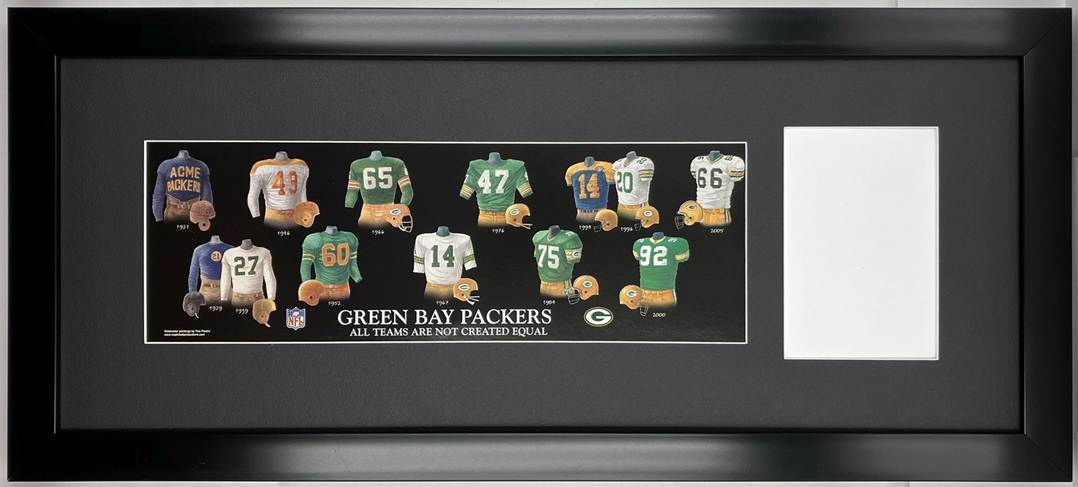
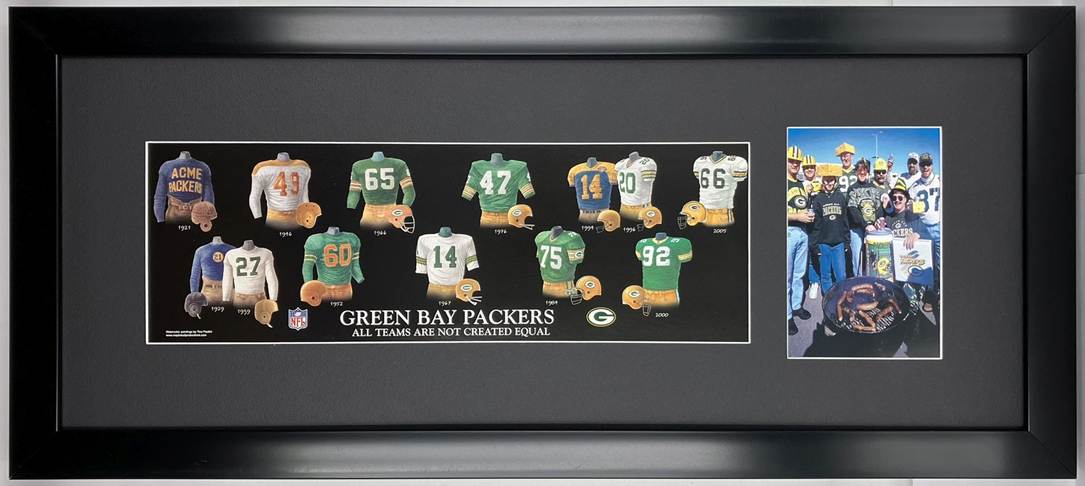
Just
add your standard 4 inch x 6 inch photo – whether it’s you in your team jersey,
or team memorabilia or something very creative, your photo possibilities are
endless because you’re only limited by your imagination.
And
you can change your photo as many times as you like!
Here are the easy steps to add your photo:
1. Use a standard 6 inch x 4 inch
photo. Keep in mind the mat will slightly overlap the photo 1/8 inch
on all four sides.
2. Turn the framed picture on its
back and bend up all the flexible tabs used to secure the picture.
3. Remove the white backing.
4. Place your photo over the mat
opening. We have marked guide lines to help you position the photo
perfectly.
5. Secure your photo on all four
sides with strips of the quality Artist’s Tape we have provided.
6. Put back the white backing and
bend back a few of the flexible tabs.
7. Look at the picture to make
sure it looks great. Then bend back the rest of the flexible tabs to
secure your framed picture. You’re Done!
We will of course include a card listing the above
steps with your order. Keep in mind you can
change your
photo as many times as you like!
And if you ever need more tape, just email us and we’ll mail you more
tape at no charge. Our email is listed
on the card.
You can also view our
how-to-do video for our “Team Up With” personalized picture (This how-to-do
video applies to all our personalized framed pictures) here:
Or you can download
our how-to-do video.
Ordering Info:
Below is an example
of the framed Personalized version, which depicts the Green
Bay Packers:
Or
(You don’t pay Sales Tax when you order from our Shopping Page.)
Click here to return to List of Teams and
Leagues
***************************************
The Montreal Canadiens: “Le Bleu
Blanc Rouge”

The Greatest-Scapes is an
accredited business of the Better Business Bureau. We have been a member of the Better Business Bureau
since 1986—and we have an A+ rating.
For more detailed
information about The Greatest-Scapes, please click the BBB Logo at left.
Thank you

E-mail: greatestscapes@hotmail.com
Click here to return to List of Teams and
Leagues
***************************************
Here then is the history of the Canadiens’
Uniforms …
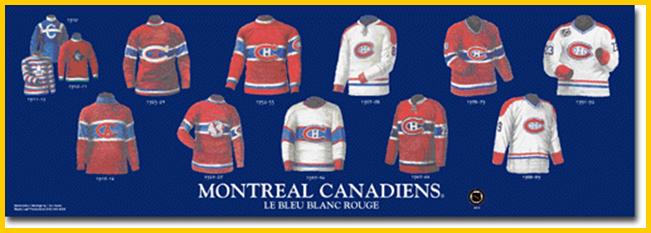
#1A.
1910 The Montreal Canadiens are considered to
be one of the richest teams when it comes to their history. They began in 1909
when the team was created by J. Ambrose O’Brien and joined the National Hockey
Association. The team was named the “Canadiens” in
reference to hard working people in Montreal. The term “les Habitants” is a
French term that in its time was used to describe rugged farm settlers in
Quebec. The Habs first game was on January 5, 1910 at
the Jubilee Arena where they beat the Cobalt Silver Kings 7-6 in overtime. This
season would see them wear a jersey that looks nothing like the Canadiens red, blue and white uniforms we know of. They
wore a blue jersey with a white “C” on the front. There was also a white stripe
that went across the chest, through the “C” and around the shoulders. The
collar was actually a turtleneck style, which was also white.
#1B.
1910-11 The team switched to red as the
predominant jersey colour, but now as we see, they
have dropped the blue and have replaced it with green. An old English “C” has
been added to the chest, over top of a green maple leaf. White and green trim
ran around the cuffs, bottom and collar, which is once again a turtleneck style.
This season would see the team change ownership to George Kendall-Kennedy’s
Club Athlétique Canadien,
where they took on the initials “CAC”.
#1C.
1911-12 The uniform goes through yet another
change as the all red look is changed to a striped red, blue and white jersey,
(it looks more like a rugby jersey). The maple leaf is still on the chest, but
the letters in it have been changed to “CAC” to match the team’s official name,
Club Athlétique Canadien.
This is the first time we see a player’s number on the sleeve of the jersey. We
will not see this again on the poster until 1957.
#2.
1915-16 This jersey is what we know the Canadiens uniform to be like today, with red as its main colour and the blue and white stripe across the chest. The
“C” on the chest is now red, like today, but there is now an “A” in the “C” for
Club Athlétique. Notice the position of the “C” is
inside both the white and blue border for this season. In years to come the
positioning of the “C” moves around. The collar is blue and is still a
turtleneck style.
The Canadiens won the NHA Championship for the first
time this season and faced the Pacific Coast Hockey Associations champions the
Portland Rosebuds for the Stanley Cup. Player/coach Newsy Lalonde
led the team to victory and the franchises first of
many Stanley Cups.
In 1917 the National Hockey League
was born with four teams, Toronto, Ottawa and two in Montreal, the Canadiens and the Wanderers. The Canadiens
would now take on the name “Club de Hockey Canadien”
and would start wearing the popular “CH” logo.
#3.
1923-24 The “C” is now white instead of red, as we know it today.
Also, this is the first time on the poster that we see the popular “CH” logo
for “Club de Hockey Canadien”. The blue and white
stripe in the middle of the chest and sleeves is now smaller than the last one
we saw and the “C” is over top of it, extending past the lines. Also white and
blue trim has been added to the bottom of the sweater. Red, white and blue go
around the collars mock turtleneck.
This would be the first season for future Hall of Famer Howie Morenz. He was playing in the Ontario Hockey Association’s
Stratford Indians. The Canadiens won their second
Stanley Cup this season over both Western challengers the Vancouver Maroons and
Calgary Tigers.
#4.
1924-25 The “CH” on the front of the jersey has been replaced with a
globe promoting the fact that the team is the best in the world after winning
the Stanley Cup a season earlier. The “CH” has moved to both sleeves instead of
on the chest.
The NHL expands with the addition of the Boston Bruins and a second Montreal
team, the Maroons. The Maroons came to Montreal with a brand new arena as well,
the Forum. Construction began in the summer of 1924 and the first game was
played in it on November 29, 1924, but not by the Maroons. The Canadiens current home, the Mont-Royal Arena had ice
problems, so they played the first game in the new building, beating the
Toronto St. Pats 7-1. They would become permanent residence, with the Maroons
in 1926.
#5.
1932-33 The “CH” on the chest is how we know them to be today, with
the “C” being red and the “H” being white. The “CH” is also just going over the
blue and white stripes across the chest; this will change in years to come.
There is a smaller “CH” on the left sleeve that is totally inside the blue and
white stripes. The mock turtleneck is almost gone and is only white now.
The league now consisted of two divisions; a Canadian Division which consisted
of the Montreal Canadiens and Maroons, Toronto Maple
Leafs, Ottawa Senators and New York Americans, while the American Division had
the Boston Bruins, Chicago Blackhawks, Detroit Red Wings (who were the Falcons
the season before) and New York Rangers. The Canadiens
had last won the cup in both 1929-30 and 1930-31, but would have to wait a
while to get there hands it again.
#6.
1945-46 The team has gone from their
familiar red uniforms, to a white jersey with red trim. The “CH” on the sleeve
is now gone and the collar is now in between a round collar and a v-neck. Also, red cuffs have been added to the sleeves.
A player of great importance to the history of hockey began this decade and was
a Montreal Canadien, perhaps the Canadien. Maurice “The Rocket” Richard played his first
full season in 1943-44, and the Canadiens won the
Stanley Cup. By his second season he did the unthinkable. He scored 50 goals in
50 games, (the season was only 50 games) becoming the first player to score 50,
(it wouldn’t be until 1961 before Bernie Geoffrion,
also of the Canadiens, would score 50 goals, and it
wasn’t until 1981 when the Islanders Mike Bossy would score 50 goals in 50
games. The next season would have Wayne Gretzky top them both with 50 goals in
39 games). This season would mark Richard’s second Stanley Cup in only his
third season.
#7.
1957-58 Several changes have been made to
the jersey. The stripes on the chest and sleeves are gone, while red has been
added to the shoulders. This is also the first time we have seen laces on the
collar, while we mark the return of numbers on the sleeves.
After winning the cup for a 7th
time in 1952-53, the Canadiens decided that they
would hang on to the cup for a while from 1955-56 to 1959-60, winning it five
straight times. Players like The Rocket, his younger brother Henri, Bernie Geoffrion, Jean Beliveau, Dickie
Moore, Bert Olmstead, Jacques Plante, and Doug Harvey
filled the Montreal line-up filling opposing defenseman’s hearts with fear. In
the 50’s the Canadiens would win the Cup 6 out of 10
seasons.
#8.
1965-66 The latest version of the red jersey
now has the laces at the collar and numbers on the sleeves.
After taking a breather from
winning the cup 5 times in a row, the Habs were back
at it again, winning two straight in 1964-65 & 1965-66 and 1967-68 &
1968-69. Jean Beliveau and Henri Richard now led the
scoring, but it seemed whoever took over the reigns
of the Canadiens, they would still win the Cup.
#9.
1978-79 After years of having the “CH”
either in between the stripes, or going just over the stripes, this is an
exception with the top half going above the stripes and the lower half above
the bottom stripes. This seems to be an odd placement from the traditional
ways. Also the numbers on the sleeves have been moved above the stripes on the
sleeve too. This is the first time we see the v-neck
style to the collar, which also has blue trim on it, (the first we have seen
since the 1924-25 jersey collar).
Reminiscent of the 50’s, the Habs took the 70’s by storm, winning 6 Cups, including four
straight from 1975-76 to 1978-79. The team was now filled with all stars like
Guy Lafleur, Steve Shutt,
Bob Gainey, Larry Robinson and Ken Dryden.
#10.
1988-89 The Montreal Canadiens jersey is a
classic and wasn’t really tampered with over these years. From the red on the
shoulders to the red cuffs on their home uniforms it was an honour
to wear the Canadiens uniform and play for the “bleu blanc rouge.”
After Montreal’s domination in the
70’s, they pulled together a new cast of great players to win the Cup again in
1985-86. The leader of the team was goalie Patrick Roy, who led the team to the
Cup in his rookie season, winning the Conn Smythe
trophy as the playoff MVP.
#11.
1991-92 Once again the Habs home jersey has
not changed and shouldn’t be changed. The only addition to the uniform is the patch
on the upper right shoulder which every team wore this year in celebration of
the NHL’s 75th Anniversary.
In 1992-93 the Canadiens make another run for the Cup
against Wayne Gretzky’s Los Angeles Kings. The Habs
beat the Kings 4 games to 1, with three of the games going to overtime. Patrick
Roy would once again lead the way, winning his second Conn Smythe
trophy.
The Canadiens hold an unbelievable status of having
won the Stanley Cup at least once in every decade since the franchise began
playing in 1910.
The Habs would move out of their historic home, the
Forum in 1996 and move into the brand new state of the art Molson Centre. The
closing of the Forum was a huge event in Montreal with alumni filling the Forum
for one last time, with the biggest ovation for Maurice Richard, the greatest Canadien to play the game.