Personalized!
A Powerful, Classy, and Creative way
to be joined at the hip with your favorite team
(And of course the uniforms print
will never go “out of Fashion” because a team’s uniforms are forever.)
You
can hang it, lean it, or let it lay flat.
Framed Version 3
Personalized
Framed Evolution History San Francisco Giants Uniform Print with Your
Photo: Framed with our classic, smooth
black frame with glass cover, it measures 11 3/4 inches high x 26 1/4 inches
long. The cost for this custom picture
is only $79 and there is a one-time $6 discount shipping cost regardless of how many you
order!
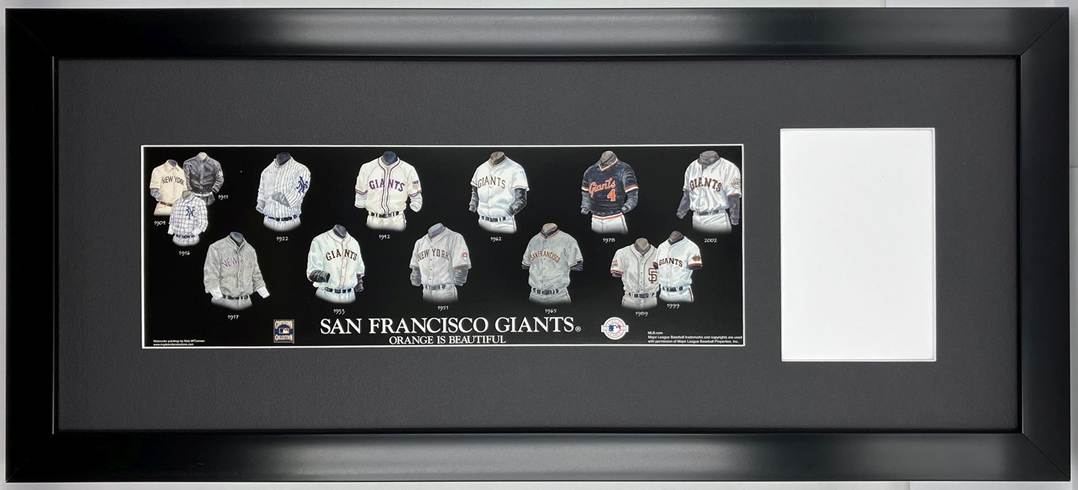
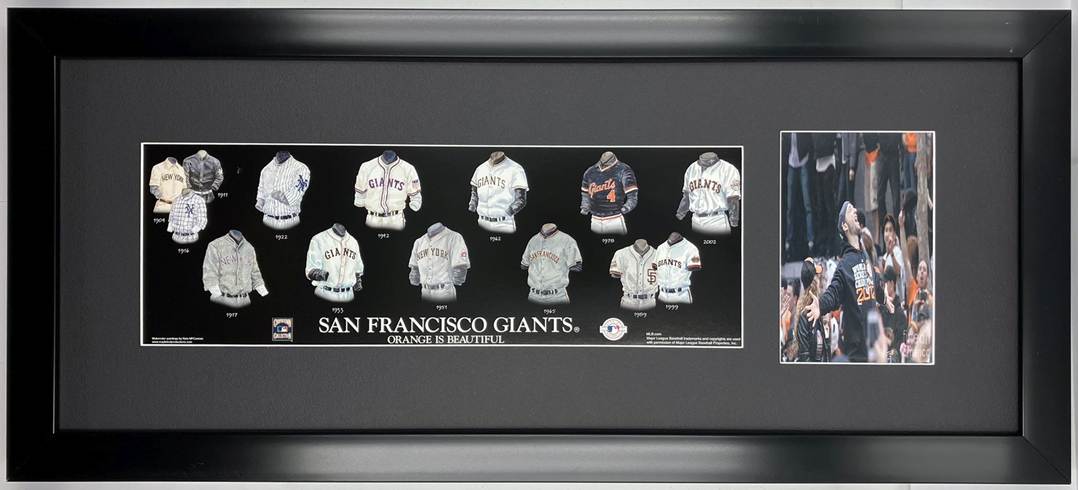
Just
add your standard 4 inch x 6 inch photo – whether it’s you in your team jersey,
or team memorabilia or something very creative, your photo possibilities are
endless because you’re only limited by your imagination.
And
you can change your photo as many times as you like!
Here are the easy steps to add your photo:
1. Use a standard 6 inch x 4 inch
photo. Keep in mind the mat will slightly overlap the photo 1/8 inch
on all four sides.
2. Turn the framed picture on its
back and bend up all the flexible tabs used to secure the picture.
3. Remove the white backing.
4. Place your photo over the mat
opening. We have marked guide lines to help you position the photo
perfectly.
5. Secure your photo on all four
sides with strips of the quality Artist’s Tape we have provided.
6. Put back the white backing and
bend back a few of the flexible tabs.
7. Look at the picture to make
sure it looks great. Then bend back the rest of the flexible tabs to
secure your framed picture. You’re Done!
We will of course include a card listing the above
steps with your order. Keep in mind you can
change your
photo as many times as you like!
And if you ever need more tape, just email us and we’ll mail you more
tape at no charge. Our email is listed
on the card.
You can also view our
how-to-do video for our “Team Up With” personalized picture (This how-to-do
video applies to all our personalized framed pictures) here:
Or you can download
our how-to-do video.
Ordering Info:
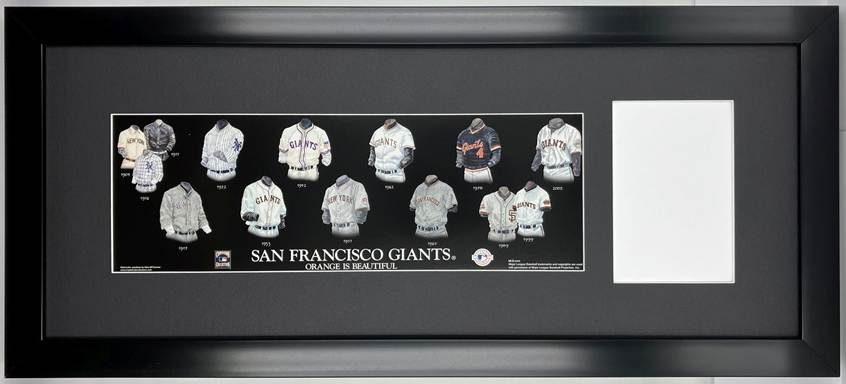
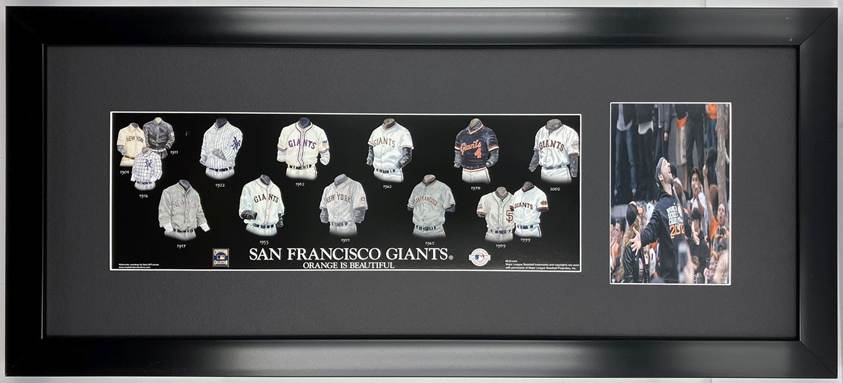
Or
(You don’t pay Sales Tax when you order from our Shopping Page.)
Click here to return to List of Teams and
Leagues
***************************************
The San Francisco Giants: “Orange
Is Beautiful”
The Greatest-Scapes is an
accredited business of the Better Business Bureau. We have been a member of the Better Business
Bureau since 1986—and we have an A+ rating.
For more detailed
information about The Greatest-Scapes, please click the BBB Logo at left.
Thank you

E-mail: greatestscapes@hotmail.com
Click here to return to List of Teams and
Leagues
***************************************
Here then is the history of the Giants’ Uniforms …
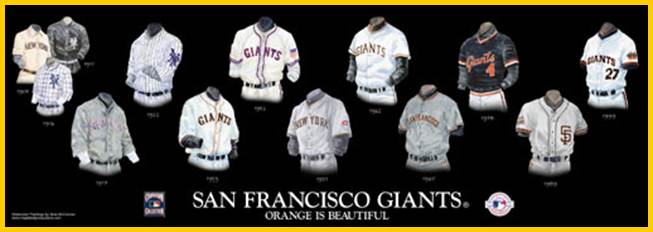
#1A.
1904 The San Francisco Giants began as the New York Gothams in 1883. In
1885 after an emotional win over Philadelphia, manager Jim Murtie calls his
players “giants”. The name of the club then becomes the Giants, and some of the
best players from the Metropolitans are moved to the team. By 1891 the club
takes over sole possession of the Polo Grounds. After many changes, fires, and
renovations the Giants would share the park with the Yankees from 1913 to 1922.
John McGraw was synonymous with the Giants and managed the team from 1902 to
1932. At first he was both player/manager, until he stopped playing at the end
of the 1906 season.
Finishing the season with a 106-47
record, the Giants take the pennant over the Cubs by 10 games. In what would
have been the second World Series, McGraw and team owner John Brush, (who
bought the team in 1902) opt not to play for the “Championship” against the
American League winning Boston Red Sox, referring to the new American League as
a “minor league”. This was the first of only two times that the World Series
would not be played in its history. After some changes to the format of the
Series, the Giants face the Philadelphia Athletics the following year. They
take the championship 4 games to 1, (with each game being a shutout) for their
first World Series crown.
The home uniform we see here is a pullover style, with four buttons down the
front. The collar is full, which was the style of the early 1900’s, and “NEW
YORK” is boldly spelled out on the front.
#1B.
1911 In 1905 when the Giants won their
first World Series, they chose to wear an alternate uniform to the home and
away jersey’s they wore during the regular season. It was an all black uniform
with a white “NY” on the front. When the Giants returned to the “Fall Classic”
this year, they chose to take on the intimidating all black uniform yet again.
This time the Giants had a new “NY” monogram that was first seen on the 1908
uniform, (the 1908 version was changed the following year to what it looks like
now on the New York Mets uniforms).
(On this poster we show the “NY”
monogram on the front of the jersey, when it was actually on the sleeve. This
will be corrected in future editions)
With another winning season of 99-54, the 1911 World Series would be a rematch
to that of 1905’s, with the Giants facing the Philadelphia Athletics. After
winning game 1, the Giants dropped the next two. The Series was halted for six
days due to rain. When game 4 was finally played, one week after the last game,
the A’s went back to work and were one game away from the Championship. New
York won the next game in 10 innings, but the hurdle was too much to overcome,
as they fell to the A’s in the next game, giving Philadelphia the Series.
A Giants note from this era: In April 1907 Giants catcher Roger Bresnahan
became the first catcher to openly wear protective leg gear. Then in June of
the same year Bresnahan is knocked out by a pitch from Reds’ pitcher Andy
Coakley. While he recovers, Bresnahan invents the batting helmet, an invention
that finally becomes mandatory in 1970.
#1C.
1916 This home uniform was one of four
uniforms the Giants had this year. Three out of the four were plaid. This has
to be one of the oddest uniforms we have seen. This wide plaid experiment only
lasted the one season, with a smaller checkered pattern taking over as the away
uniform in the following year. This is a time in baseball when the teams did a
lot of experimentation in terms of uniform design and pattern. They would
redesign the entire uniform on a seasonal basis.
The Giants win a record 26 games in a row this season, but still finish in the
middle of the National League standings with an 86-66 record.
#2.
1917 They only stuck with this tight cross-hatching road uniform for one
year, but the uniform experimenting was not over. A mini cadet collar is in
place now, instead of the full collar that was seen earlier. The “NEW YORK “ on
the front is now a purple color.
Since the Giants last World Series Championship in 1905, they had been to the
post season three times, and come up empty in each. Finishing this season with
a 98-56 record, they found themselves back in the Fall Classic once again, this
time against the Chicago White Sox. The Sox, led by Eddie Collins, Buck Weaver
and Joe Jackson insured the Giants fate with a fourth straight World Series
defeat, 4 games to 2.
#3.
1922 Wide blue and white pinstripes, which the Giants had been flirting
with since 1911, covered this home uniform. The “NY” logo is once again on the
left arm.
The year before this was the first all New York World Series, which was won by
the Giants. This years post season saw a re-match, as the Giants finish the
season with a 93-61 record. With the Giants already up a game, they went into
the second scoring a quick 3 runs in the first. The Yanks came back to tie it,
and the game went into extra innings. After the tenth, the game was called due
to darkness, although it was still light out. Due to the “tie”, there were
actually five games played this Series, although the Giants won the title 4
games to none. The Giants would make appearances in the next two World Series’
as well, but wouldn’t win either.
#4.
1933 On this home uniform we can see the first use of the colors the
Giants wear today, black lettering with orange outlines on a white jersey, and
black undershirt. Also we notice the orange piping that goes around the collar
and down the buttons, and around the sleeves. These colors would only last
three seasons, as they would go back to blue uniforms.
In June of 1932 Giants longtime manager John McGraw steps down and passes on
the managerial duties to his first baseman Bill Terry. In Terry’s first full
season as manager, the team finishes 91-61, and heads to the World Series as
underdogs to the Washington Senators. It would be pitching that would decide
this series, as the Giants had an impressive 1.53 ERA. New York would take the
title in five games.
A 1930’s Giants note: On June 15th
1938 the Giants played the first game ever played under the lights in New York,
and 23 year old Reds pitcher Johnny Vander Meer pitches a no hitter -
amazingly, he pitched another no hitter 4 days earlier vs the Boston Braves.
This is the only time the same pitcher pitches back-to-back no hitters in 20th
century major league history.
#5.
1942 The Giants followed one of the trends that took baseball by storm,
the zipper. Almost all of the Major League teams embraced this little invention
and sported it willingly on the field. The home uniform colors have gone back
to the red, white and blue, since the last uniform we saw. The piping around
the collar and down the front is more predominant than ever, and is both red
and blue. There are even double stripes around the arms.
December 1941 to November 1945 America goes to war. Should the able bodied
athletes of baseball be fighting for their country overseas? The commissioner
of Baseball and the President of the United States of America have a chat about
the game’s role in the war. Both agree that the game is too important to the
people. It will boost the morale of the entire Country, and get their minds off
of the war effort for a short time.
The Wartime patches that were sported by all levels of professional baseball
were the Health patch as well as the Stars and Stripes patch. The Health was
only worn for the 1942 season, part of a health and fitness awareness campaign.
The Stars and Stripes was worn from 1943 to1945.
The Giants appoint yet another player/manager this year in Mel Ott. He would
not have as much luck as his predecessors, as the team finishes with a 85-67
record. The Giants seemed to lose more players to the war effort, than any
other team.
#6.
1951 As we see on this road uniform, the Giants have gone back to the
colors we saw in the 1933 uniform, and the colors we know the Giants to be
today. Unfortunately we do not have any information on the patch that was worn
on the left sleeve.
“The Giants win the pennant!!! The Giants win the pennant!!! The Giants win the
pennant!!!” The New York Giants had a 16 game winning streak this year. At one
point they were 13.5 games behind the Dodgers, but finished the season going
98-59. The energy that sparked the Giant performance was none other than rookie
Willy Mays, and led by the Giant manager Leo Durocher. The Giants caught the
Dodgers and forced a playoff. The Giants won off of Bobby Thompson’s long bomb
that brought in three runs, in the bottom of the 9th of the 3rd
game. Their elation was short lived however; the Yankees won another World
Series in 6 games. Nothing will ever take away the amazing performance from the
underdog team that won their pennant after an unforgettable series.
#7.
1962 As we see on this home uniform, even though the Giants have a new
home, the jersey has stayed the same. It is a very classic design with very
little piping around the collar and sleeves.
The Giants left New York in 1957 in tandem with the Brooklyn Dodgers. The
Giants went to San Francisco, and the Dodgers went to Los Angeles. New York
city went from 3 teams down to 1. They played their old neighborhood rivals the
Yankees for the World Series but were overcome in the 7th game 1 to
0. The New York Mets started as a franchise this year and to honor their
predecessors they chose orange for the Giants and blue for the Dodgers, a color
scheme that is still in effect today. 1962 is the 3rd season that
the Giants are playing at Candlestick Park. The players would wear heavy
undershirts or windbreakers under their jerseys because of the close proximity
of the park to the ocean. Even in the heat of summer the park had a nasty chill
to it. However, this did not stop the team from winning, as they go 103-62 on
the season.
#8.
1965 This road jersey is a testament to how simplicity works. Little or
no useless details, just letters, stripes and buttons. Traditionally a baseball
teams’ road jersey is darker than the home, as well it will say the teams city
on the front. These two clues makes telling the road from the home jersey a lot
easier.
The Giants finish the season in
second place only two games behind the Dodgers with a record of 95-67. Willie
Mays wins his second National League MVP award as he leads the league in home
runs with 52 and leads the Giants with a .317 average and 112 RBI. On the
mound, Juan Marichal leads the Giants pitching staff with a 22-13 record.
#9.
1978 This is a double knit 3rd jersey that most of the other
teams succumbed to during the 70’s and early 80’s. It was a pullover style, synthetic
material. The pants were called “Sans-a-Belt” because of the elastic material
of the waistline. This is the 2nd year that the numbers appear on
the front of the jersey. Uniform numbers first made their appearance on the
front of a uniform in 1952 - the Brooklyn Dodgers were the first team to wear
uniform numbers on the front of their jersey. The Braves followed suit in 1953,
and the Reds joined in beginning in 1956. The 1916 Cleveland Indians actually
wore a uniform number on their sleeve, but it wasn’t until the ’52 Dodgers that
the number made it to the front.
The Giants finish the season third
in the NL West, 6 games behind the Dodgers with a record of 89-73. Jack Clark
led the Giants at the plate hitting 25 homers and 98 RBI. Vida Blue led the team
in wins with a 18-10 record.
#10.
1989 Thank goodness, the double knit of the 70’s and 80’s is over. The
S.F. monogram started in 1983 on their road uniforms, and lasted until 1992.
The patch on the left sleeve is “the Battle of the Bay” for the World Series
against the Oakland A’s, (the two sides of the Golden Gate bridge) this year.
With a 92-70 record, the Giants take the NL West by 3 games over the Padres and
face the Chicago Cubs for the NL Pennant. The Giants take the series 4 games to
1 and go on to face the Oakland A’s. The 1989 World Series wasn’t going well
for the Giants, they had lost their first 2 games, and before the start of game
three an earthquake rocked the Bay Area, causing minor damage to Candlestick
Park, but major damage to the surrounding areas. The game was postponed for ten
days. The time off didn’t help the Giants at all as the A’s won the next two
games to sweep the series.
#11.
1999 This Giants home jersey is similar to the 1962 uniform. The script
is a little bolder, but the white, black and orange are still in tact. The
patch on the left sleeve is the “Tell it Goodbye” patch. The team paid its last
respects to Candlestick Park that was soon to be torn down.
This would be the last season the Giants would play in Candlestick Park and
they would move on to 3Comm Park for the 2000 season. The Giants are led by
Barry Bonds who hits 34 homers with 83 RBI, Ellis Burks who hit 31 homers and
96 RBI, J.T. Snow with 24 home runs and 98 RBI, while Jeff Kent hits 23 homers
and drives in 101 RBI. The team makes a run for the NL West, but key injuries
to Bonds, Burks and Kent slow the team down as they finish in second place
behind the Diamondbacks, going 86-76. But then comes 2010. It was a very good year: CONGRATULATIONS CHAMPIONS OF THE WORLD!!!