Personalized!
A Powerful, Classy, and Creative way
to be joined at the hip with your favorite team
(And of course the uniforms print
will never go “out of Fashion” because a team’s uniforms are forever.)
You
can hang it, lean it, or let it lay flat.
Framed Version 3
Personalized
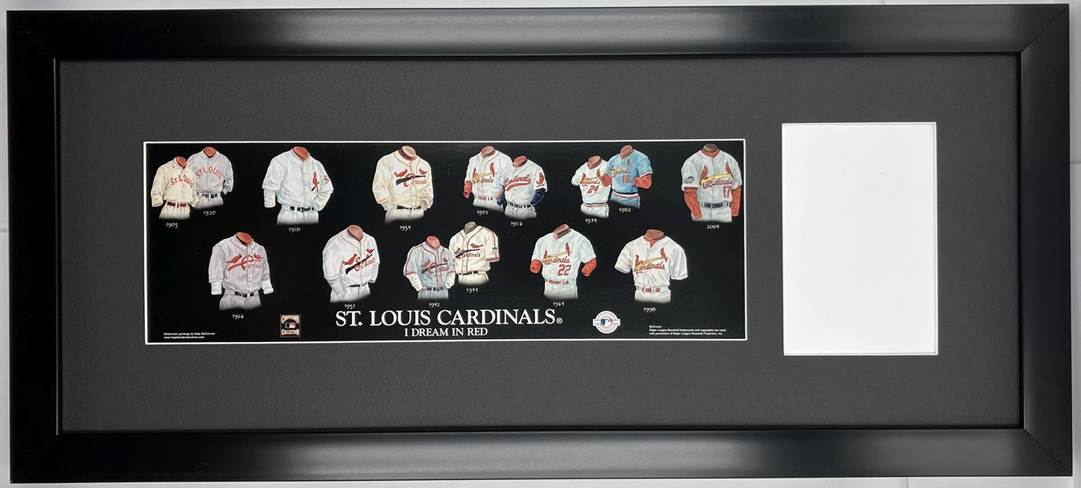
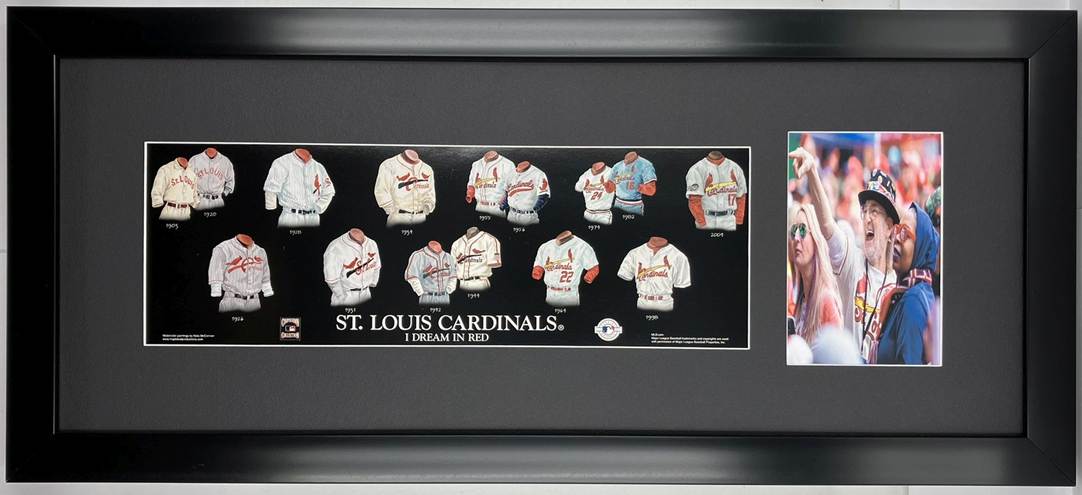
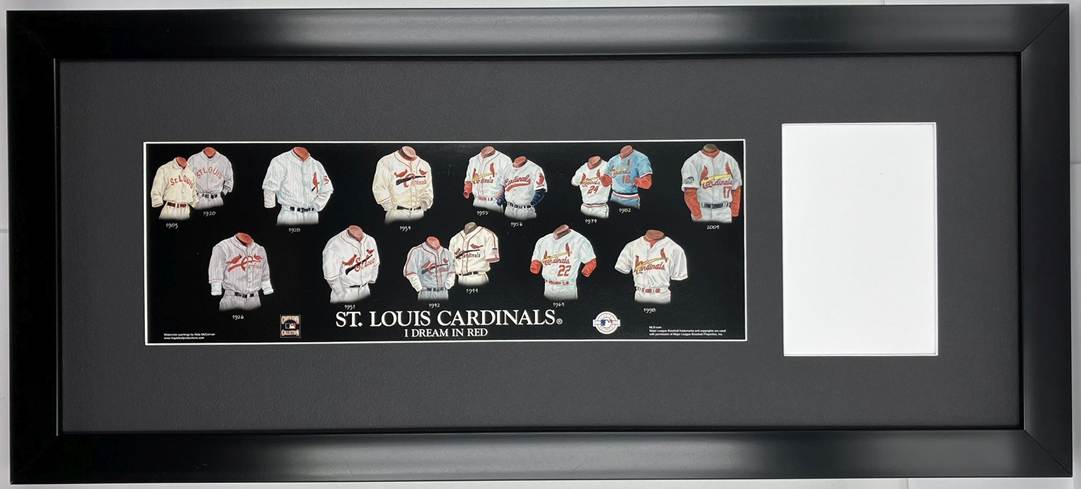
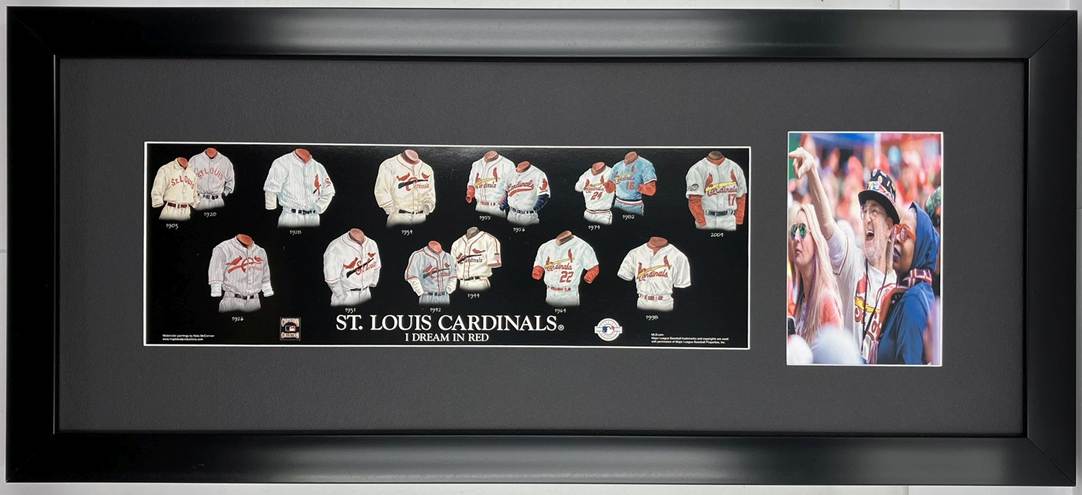
Framed Evolution History Cardinals Uniform Print with Your Photo: Framed with our classic, smooth black frame
with glass cover, it measures 11 3/4 inches high x 26 1/4 inches long. The cost for this custom picture is only $79 and there is a one-time $6 discount shipping cost regardless of how many you
order!
Just
add your standard 4 inch x 6 inch photo – whether it’s you in your team jersey,
or team memorabilia or something very creative, your photo possibilities are
endless because you’re only limited by your imagination.
And
you can change your photo as many times as you like!
Here are the easy steps to add your photo:
1. Use a standard 6 inch x 4 inch
photo. Keep in mind the mat will slightly overlap the photo 1/8 inch
on all four sides.
2. Turn the framed picture on its
back and bend up all the flexible tabs used to secure the picture.
3. Remove the white backing.
4. Place your photo over the mat
opening. We have marked guide lines to help you position the photo
perfectly.
5. Secure your photo on all four
sides with strips of the quality Artist’s Tape we have provided.
6. Put back the white backing and
bend back a few of the flexible tabs.
7. Look at the picture to make
sure it looks great. Then bend back the rest of the flexible tabs to
secure your framed picture. You’re Done!
We will of course include a card listing the above
steps with your order. Keep in mind you can
change your
photo as many times as you like!
And if you ever need more tape, just email us and we’ll mail you more
tape at no charge. Our email is listed
on the card.
You can also view our
how-to-do video for our “Team Up With” personalized picture (This how-to-do
video applies to all our personalized framed pictures) here:
Or you can download
our how-to-do video.
Ordering Info:
CLICK HERE to view or buy The
Personalized Cardinals Framed Version 3 “I Dream In Red” at AMAZON.COM
Or
(You don’t pay Sales Tax when you order from our Shopping Page.)
Click here to return to List of Teams and
Leagues
***************************************
The St. Louis Cardinals: “I Dream
In Red”
The Greatest-Scapes is an
accredited business of the Better Business Bureau. We have been a member of the Better Business
Bureau since 1986—and we have an A+ rating.
For more detailed
information about The Greatest-Scapes, please click the BBB Logo at left.
Thank you

E-mail: greatestscapes@hotmail.com
Click here to return to List of Teams and
Leagues
***************************************
Here then is the history of the Cardinals’ Uniforms …
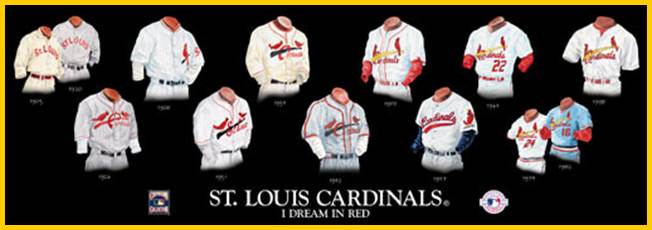
#1A.
1903 The St. Louis Cardinals were originally known as the St. Louis
Brown Stockings. The Brown Stockings were a charter member of the National
League in 1876, and were originally owned by John B.C. Lucas. That year they
finished with a record of 45-19, second to Chicago’s 52-14 mark. Remarkably,
and perhaps a sign that the game has changed in the last 125 years, St. Louis’
pitcher George Bradley pitched all 64 games, thus going 45 and 19 with a 1.23
ERA. The next season Bradley was signed by Chicago and he went 18 and 23, while
his ex mates went 28-32 with two pitchers sharing the duties.
Partly because of Bradley’s
departure, there was talk of a scandal, and St. Louis owner John Lucas withdrew
his team from the league after the 1877 season. In 1881 the team was taken on
by Chris Von Der Ahe for no other reason than to promote his beer business in
1881, but he joined the new American Association for the 1882 season. They
became known as just the Browns and went on to win four straight Pennants from
1885 to 1888. In 1891 the American Association folded and the Browns re-entered
the National League. In 1898 they were sold to Frank and Stanley Robinson,
owners of the National League Cleveland Spiders. The new owners moved the best
Spiders players to St. Louis and re-named the team the St. Louis Perfectos.
They wore red hats and red stockings, prompting a female fan to remark “What a
lovely shade of cardinal”. St. Louis sportswriter Willie McHale overheard this
and began using it in his articles. The name stuck and thus the Cardinals were
born.
The first jersey we see is a home
jersey with a very prominent collar. Note also that the jersey has four buttons
down the front, a jersey style known as a “pullover” style jersey because it
had to be pulled over the head. This style was common in jerseys throughout
baseball at this time. We believe the first major league team to wear a
completely buttoned front jersey (ie one that didn’t have to be pulled over the
head) was the 1909 Phillies, followed by the 1911 Cubs. The pullover style
jersey finally disappeared after the 1939 season (the A’s were the last team to
wear it), but of course pullovers resurfaced in a big way with the double knit
era of the 70’s and 80’s.
Note also that even though this is
a home jersey, it reads “St. Louis” and not the team nickname. In this era it
wasn’t unusual for teams to wear the same inscription on their home & away
jerseys, and the practice of wearing the city name on the road and the team nickname
at home didn’t really come into vogue until the early 40’s (the 1914 Cubs
appear to have been the first team to adopt the fashion of team nickname at
home, city name on the road).
#1B.
1920 By 1920 the lapel style collar has disappeared from the uniform.
Note also that the jersey now buttons completely and thus is no longer a
“pullover” style jersey. If you look closely, you’ll see that there is a center
belt loop, which secured the belt buckle off to one side. Players in the 1st
part of the 20th century usually wore the belt buckle to one side so
they could prevent injury when sliding into a base.
After several sales of the team
Sam Breadon becomes the majority stockholder of the Cardinals and in 1919 makes
38 year old Branch Rickey the Vice President and General Manager. These two men
slowly and carefully developed the Cards into a competitive team for many years
to come.
Except for the 1914 Cards who went
81-72, and 1917 when they were 82-70, the period from 1900 to the early 1920’s
was pretty woeful for the Cards. One bright light was the emergence of Rogers
Hornsby as a gifted batter – in this
1920 season he hit .370, then .397 in 1921, .401 in 1922, .384 in 1923, a
remarkable .424 in 1924, and .403 in 1925 – three .400+ seasons in a 4 year
period! Only Ted Williams has hit .400 since then, and that was only once -
.406 in 1941. By the time Hornsby retired in 1937 after 23 seasons, his
lifetime average was .358 – good for 2nd place all time (behind Ty
Cobb’s .367 lifetime average) and two triple crown titles (1922 and 1925). But
even Rogers Hornsby couldn’t propel the Cards into the playoffs, and in 1920
they finished 75-79.
#2.
1926 This 1926 road uniform has several new additions from the last
jersey we saw. First off, pinstripes have been added. As best we can tell, the
first instance of pinstriped uniforms was in 1907, when the Boston Braves’ road
uniforms were made from a gray flannel with a fine green pinstripe. Later that
same year the Cubs had a new gray uniform with fine pin striping made for the
World Series - they wore it for the World Series opener in Chicago and were
later reprimanded by the league for not wearing a white uniform at home. The
Yankees, most often associated with pinstripe uniforms, first wore a pinstriped
uniform for one year at home in 1912 (the New York Times wrote about their 1912
home opener “The Yankees presented a natty appearance in their new uniforms of
white with black pin stripes”), then every year from 1915 to the present. The
Cards first pinstripe was in 1918, when they wore it both at home and on the
road.
Note
also the red piping that will become a trademark of Cardinal uniforms in years
to come – see how in 1926 it doesn’t extend down the buttons but stops right at
the team nickname. Note as well the fact that the team nickname is written on
the jersey as opposed to the city name. Finally, and perhaps most importantly,
note the two cardinals balanced on a single bat. This concept was first
introduced in 1922, and both the birds and the bat have changed a number of
times over the years. Over time we’ll see the bat go from red to black to
yellow, while the cardinals themselves will take on quite a number of
appearances.
But let’s talk about the 1926 season
– the first time the cardinals win the National League pennant – they finish
89-65 under 1st year player-manager Rogers Hornsby, edging the Reds
by 2 games. Thus the Cards advanced to their first World Series, facing Babe
Ruth and Lou Gehrig and the rest of the 91-63 New York Yankees.
St. Louis is led by 39 year old
pitcher Grover Cleveland Alexander, who was traded to the Cards from the Cubs
in midseason. The mighty Yankees took a 1-0 and 3-2 series leads, including a
10-5 win in game 4 that featured 3 home runs by Ruth. But the Cards roared back
to win game 6 in New York by a 10-2 score, then hung on in game 7 for a hard
fought 3-2 victory in Yankee Stadium to capture their first ever World’s
Championship. Alexander pitched 20+ innings in the series, and went 2-0 with a
0.89 ERA.
#3.
1928 The 1927 Cards jersey was the first time we saw only the cardinal
logo with the abbreviation “St. L” on the jersey sleeve, as well as the words
“World Champions” circling the cardinal logo. By 1928 the celebrating is over,
but the lone cardinal on a bat logo remained for this 1928 home uniform. Note
also the red piping only on the collar – a very subtle touch.
After going 92-61 in 1927 and
finishing 2 games behind the Pirates, the 1928 Cardinals go 95-59 and make it
back to the World Series for the second time in three years. Once again the
Cards face the New York Yankees, who won a remarkable 110 games against only 44
losses in 1927, then came right back and went 101-53 in 1928.
This time out, there were no Grover
Cleveland Alexander stories, as the 41 year old pitches 5 innings over two
games and posts a 19+ ERA. But the whole Cardinals team was overwhelmed,
hitting a paltry .206. Ruth, on the other hand, goes 10 for 16 and Gehrig 6 for
11 (4 of which were home runs). Enough said.
#4.
1931 As we see on this home white uniform, the Cards have dropped the
pinstripes, and have brought back the two cardinals-on-a-black-bat logo, with
“St. Louis” script as opposed to the team nickname. This uniform was identical
in design both at home and on the road.
The Cardinals’ wonderful run
continues into the 30’s. In 1930, the Cards finish an impressive 92-62, then go
on to face the powerhouse 102-52 Philadelphia A’s, a team which some have
called “the greatest team you’ve never heard of” (they won the World Series in
1929 and again in 1930). The Cards fall to the A’s 4 games to 2, but 1931 will
tell a different tale.
The 1931 Cards finish with their
best record ever – 101-53, 13 games ahead of their nearest rival (the Giants).
Meanwhile, the mighty A’s amass a 107-45 record, setting up a repeat match up.
In a see saw series, the Cards
take 2-1 and 3-2 series leads, but the A’s tie it up in game 6 with a 8-1
shellacking of the Cards. Thus a dramatic 7th and deciding game was
in order, and the Cards prevailed with a nail biting 4-2 win as the A’s came
back for 2 in the top of the ninth. The Series heroes for the Cards were rookie
Pepper Martin, who batted .500, stole 5 bases, and legged out 4 doubles, while
starting pitchers Bill Hallahan and Burleigh Grimes each collected 2 wins
apiece and Hallahan added the save in the 7th game.
This was the Cards’ 4th
World Series appearance in 6 years (1926, 1928, 1930 and 1931) and second win
(1926 and 1931), and they weren’t done yet!
#5.
1934 The infamous “Gas House Gang”, a
moniker which described the 1934-35 Cardinals' fiery attitude toward the game
and their fun-loving style of play at the time,
was made up of a bunch of colorful characters, including brothers Dizzy and
Paul Dean, Pepper Martin, Joe Medwick, Frankie Frisch, and Leo Durocher. They
were a group of guys that loved baseball more than anything and loved having
just as much fun off the field.
At the start of the season Dizzy
predicted that he and his brother, (a rookie) would win 45 games between them.
Dizzy won 30 himself, and his brother 19, for an impressive total of 49 wins
for the two brothers. Their 49 wins accounted for more than half the Cardinals
regular season wins, and the Cards go 95-58 for a 2 game victory over the
Giants. Their opponents this time out – the 101-53 Detroit Tigers led by Hank
Greenberg, Charlie Gehringer, Goose Goslin and Mickey Cochrane (in fact, 7
Tigers regulars hit over .300).
In another close World Series, the
Cards fall behind 3 games to 2 heading back to Detroit, and things look grim.
But they scratch out a 4-3 win in game 6, capped by Paul Deans game winning 7th
inning RBI. And Dizzy is back on the mound for game 7 and he tosses a complete
game 6 hitter as the Cards wallop the Tigers 11-0. When all is said and done,
the Dean brothers account for all 4 Cardinals victories and Martin and Medwick
are the hitting heroes.
As a side note to the 7th
game, in the 6th inning, St. Louis’ Joe Medwick slides hard into
Tigers third baseman Marv Owen, sending the hometown crowd into a frenzy. When
Medwick took left field in the bottom of the inning, the crowd started hurling
fruit, bottles and everything else they could at him and was taken out of the
game for his own protection.
The home uniform worn by the
“Gang” that we see here has changed very little from the last one we saw, with
the exception of “Cardinals” replacing the city name on both their home and
away uniforms. Note also the way the red piping stops at the team name, a
Cardinal “trait” since the early 20’s.
This was the Cards’ 5th
World Series appearance in 9 years (1926, 1928, 1930, 1931 and 1934) and third
win (1926, 1931 and 1934), and they’ll catch their breath for a couple years
before cranking it up again in the 40’s.
#6.
1942 During the 40’s, 50’s and 60’s many teams used zippered jerseys
instead of the more traditional button front jerseys, while a handful of teams
wore them well into the 70’s and even the 80’s. The Reds, Yankees and A’s were
the only 3 pre-1977 teams that never wore zippers. The 1937 Cubs were the first
team to wear a zippered jersey, and as far we can tell the 1988 Phillies were
the last to wear one.
The first year the Cardinals wore
a zippered jersey was 1939. Notice how the red trim on this road uniform has
changed to become a much more prominent design element on this 1942 home
jersey, even around the “belt tunnel.” For those of you that haven’t heard of
this expression before, a belt tunnel is really just a 6”-8” wide belt loop.
December 1941 to November 1945,
America goes to war, and the question is raised, should able-bodied athletes of
baseball be fighting for their country rather than playing baseball? Baseball
Commissioner Landis asked President Franklin D. Roosevelt what to do - here is
part of Roosevelt’s reply:
“I honestly feel it would be best
for the country to keep baseball going. There will be fewer people unemployed
and everybody will work longer hours and harder than ever before… Here is
another way of looking at it - if 300 teams use 5,000 or 6,000 players, these
players are a definite recreational asset to at least 20,000,000 of their
fellow citizens - and that in my judgment is thoroughly worthwhile.”
Wartime sleeve patches were worn
by all levels of professional baseball teams between 1942 and 1945. A “Health”
patch (seen here) was worn during the 1942 season, part of a war-time health
and fitness awareness campaign, and from 1943-1945 a “Stars and Stripes” was
worn.
Towards the end of the season the
Cards trailed the Brooklyn Dodgers by 10½ games, then went on to win 43 of
their last 51 games to finish with a 106-48 record and pass the Dodgers for the
NL Pennant (the Dodgers finished 2 games back at 104-50). The 1942 Cardinals
team is considered to be one of the best ever, featuring among others Enos
Slaughter, rookie and NL MVP Stan Musial, and pitcher Mort Cooper, who went 22
and 7 with a 1.77 ERA.
The Cards faced the 103-51
Yankees, led by Dimaggio, Gordon, Rizutto and Dickey. After losing the first
game in the World Series, the Cards storm back to win four in a row, to collect
their fourth World Series Championship (1926, 1931, 1934 and 1942).
It should be noted that the
1942-44 Cardinals have to be considered one of the best baseball teams in
history - they are one of only 4 teams in baseball history to win 100 games
three years in a row. In 1942 they went 106-48; in 1943 they went 105-49 (they
went on to lose 4 games to 1 to the Yanks); and in 1944 they also went 105-49
(they beat their stadium sharing AL counterparts the Browns 4 games to 2 in the
only “Stadium Series” ever played). The three other teams to win 100 games
three years running were the 1929-31 Philadelphia A’s, the 1969-71 Orioles and
the 1997-99 Braves.
Thus in the 21 years from 1926 to
1946, the Cards made it to the Series 9 times (1926, 1928, 1930, 1931, 1934,
1942-1944, 1946) and won it all 6 times (1926, 1931, 1934, 1942, 1944, 1946).
Much of the credit has to go to Branch Rickey, the crafty general manager of
the Cards during this period of time – he is credited with having one of the
most extensive minor league systems ever assembled – it’s been said that at
their peak the Cards had more than 30 farm teams, a far cry from today’s 3 or 4
farm teams per major league club.
#7.
1955 This home uniform starts to set the pattern of Cardinals uniforms
to come for the next 40-50 years – look how similar this jersey is to the 1998
version. The bat has now become yellow (it changed in 1951 after being black
and red over the last 30 years). The red piping has been slimmed down from the
1942 jersey, and follows the classic line around the collar and down the front
of the jersey. Note also the red belt, which we haven’t seen in this poster
since the 1903 uniform. Finally, note that the zippered front is still in effect,
although this would be the last year for the zipper on a Cardinals uniform.
In 1953 the Cardinals were sold to
Gussie Busch of the Anheuser-Busch Company, and at the end of the season the
Cards home, Sportsman Park, would be renovated and renamed Busch Stadium. Mr.
Busch had wanted to rename the Stadium “Budweiser Stadium”, but the league
thought that was too commercial and turned down the request – funny how times
change, now it seems every Stadium has to have a commercial sponsor.
The 1955 Cards are still led by
the immortal Stan Musial, but he can’t do it all himself as the Cards struggle
to a 68-86 record.
#8.
1957 The two cardinals sitting on the bat have disappeared, and just the
Cardinals name in script appears on the front of this road jersey. Also new is
an underline “flourish” or “swoosh” under the team’s name. This flourish, as
well as the cardinal logo on the left sleeve, first appeared in 1956 and was
never seen again after 1957.
Over the years many teams have worn
a “swoosh” under their team name. This style was introduced to baseball by the
1932 Cubs, and has been worn by many teams since then. As mentioned above, the
Cardinals would “swoosh” it for two seasons – 1956 and 1957.
It was also unusual for the Cardinals
to have a blue undershirt and a black belt, which once again only lasted the
two seasons. Both home and away uniforms feature the team nickname as opposed
to the city name.
At the time, Stan Musial was
playing in his 16th season, and had established a National League
record for most consecutive games played at 895 until he was forced to sit out
a game mid way through the 1957 season due to injury. He still won the NL
batting title with a .351 average in 134 games, gathering 176 hits, 102 RBI and
29 home runs. Remarkably, Musial would go on to play 6 more seasons and end his
career in 1963 with top 10 all time records in 8 offensive categories (5th
in games; 9th in slugging; 5th in at-bats; 4th
in hits; 3rd in doubles; 6th in runs; 5th in
RBI; 9th in walks).
#9.
1964 As we see on this home uniform, numbers have started appearing on
the front of the jersey, something that began for the Cards in 1962. This 1964
jersey is very similar to the Cardinals current jersey. Simplicity is key:
there is no piping, no zipper and lots of white space. The bat color, belt
color, and placement of the birds remain almost identical to today’s jersey.
Uniform numbers first made their
appearance on the front of a uniform in 1952 - the Brooklyn Dodgers were the
first team to wear uniform numbers on the front of their jersey. The Braves
followed suit in 1953, and the Reds joined in 1956. The 1916 Cleveland Indians
actually wore a uniform number on their sleeve, but it wasn’t until the ’52
Dodgers that the number made it to the front of the jersey. The Cards, as
mentioned above, joined the parade in 1962.
A few months into the 1962 season
the Cards make a trade with the Cubs. One of the players involved is outfielder
Lou Brock. In the 103 games he played in St. Louis in 1962, he would score 81
runs. The team jumps from 7th place at the time of the trade to
first by the end of the season (with a 93-69 record, good for a slim 1 game
margin over both the Reds and the Phillies, and 3 games up on the Giants – what
a finish!). With another Pennant, the Cards would face Yogi Berra’s powerful
New York Yankees in the World Series.
After losing game 2, Cardinals
pitcher Bob Gibson came back to pitch complete games in both game 5 and game 7
on just 2 days rest – that after having pitched all 10 innings in game 5. He
didn’t have to pitch the 11th inning thanks to Tim McCarver, who
belted a three run homer in the top of the 10th. McCarver had an
awesome Series, going 11 for 23 for a .478 average.
In the 7th and deciding
game superman Bob Gibson struck out 9 Yankees, giving him a total of 31 K’s for
the Series. The Cards won the game 7 to 5, and took the Series 4 games to 3.
Gibson was named the World Series MVP.
#10A.
1974 This home uniform is of a double-knit style that most major league teams
succumbed to during the 70’s and early 80’s. It was a pullover style, made of
stretchy, synthetic material. The pants were called “Sans-a-Belt”’s because the
elasticized waistline eliminated the need for a belt. The 1970 Pirates were the
first double-knit - sans-a-belt team, and the Cards and Astros joined them in
1971. By 1975 two thirds of major league teams, including the Cards, had
succumbed.
The Cards had several notable
accomplishments in 1974. Lou Brock broke the single season stolen base record
by stealing a total of 118 bases, breaking Maury Wills’ record of 104 set in
1962. With these 118 thefts he leaps from ninth to second on the all time
stolen base list. Bob Gibson strikes out his 3000th hitter, and is
only the second player to do so at this time, (he currently ranks 12th
in career strikeouts with 3117 K’s). And on September 11th the Cards
and Mets play the longest night game on record, 25 innings.
In the standings, the Cards finish
2 games out of first in a very tight NL East. Their record of 86-75 is 2 behind
the Pirates.
#10B.
1982 This road uniform is still the double knit “sans-a-belt” style,
however it is highly unusual because of the colors. The Cardinals abandon the
clean white uniform and go for baby blue. This seems like an odd choice for a
team that has traditionally been wrapped in cardinal red and white.
On the basis of a 92-70 regular
season, the workmanlike Cards - led by Ozzie Smith, Lonnie Smith, Keith
Hernandez and Willie McGee - enter their first National League Championship
Series since it was established in 1969. They sweep aside the Atlanta Braves in
three straight games to capture their first Pennant since 1964, and face the
Milwaukee Brewers in the World Series.
After being down three games to
two in the Series and facing elimination, the Cards returned home to Busch
Stadium for games 6 and 7. In game 6, the Red Birds embarrass the Brew Crew 13
to 1, including a 6 run 6th inning. Then in the 7th and
deciding game, the Cards overcome a 3-1 deficit in the bottom of the 6th
to take the lead 4-3, then add 2 insurance runs in the 8th to seal a
6-3 victory. Dane Iorg goes 9 for 17 and Jose Andujar wins 2 and posts a 1.35
ERA, but Darrell Porter’s steady play and timely hitting earns him the Series
MVP.
A side note: 1982 would mark shortstop Ozzie Smith’s third consecutive Gold
Glove, on his way to winning 13 in a row.
#11.
1998 The bat color, belt color, and placement of the bird’s remains
almost identical to the 1955 jersey. As you can see on this home uniform there
isn’t much difference between the uniform of today and how it looked over 40
years ago. Some things do stand the test of time, and the Cards’ clean, classic
look is something to admire.
Ever since the 1994 cancellation of the World Series due to a player lockout,
baseball fans had been looking for something to cheer about. It came in 1998 in
St. Louis and Chicago.
Cardinal slugger Mark McGwire went
head to head with the Cubs Sammy Sosa for the single season home run record of
61 set by the Yankees Roger Maris in 1961. In a home run derby that gripped the
entire nation, the two sluggers went toe to toe on the evening sports casts and
in the headlines of the nation’s daily newspapers. Every morning even casual
fans had to know – how’d they do last night?
On September 7th
McGwire reached the magical plateau of 61, and kept going. The next night he
created a new record with his 62nd homer, but the question was, how many
more could he hit? Sosa broke the 61 mark as well, and then caught and passed
McGwire on September 25th as he hit his 66th dinger.
Sosa’s lead would last for 45 minutes as McGwire tied the mark, then hit two
the next day to take over the lead. Meanwhile, Sosa paused on 66.
On the last day of the season for
the Cards, “Big Mac” hit another two outta the park, setting the new single
season home run record with 70 dingers. The fans had come back, and what they
witnessed was pure magic. Thanks Sammy, and thanks Mac! And in 2006 Cardinal fans had something else
to cheer about: ANOTHER WORLD SERIES
TITLE!!!