Personalized!
A Powerful, Classy, and Creative way
to be joined at the hip with your favorite team
(And of course the uniforms print
will never go “out of Fashion” because a team’s uniforms are forever.)
You
can hang it, lean it, or let it lay flat.
Framed Version 3
Personalized
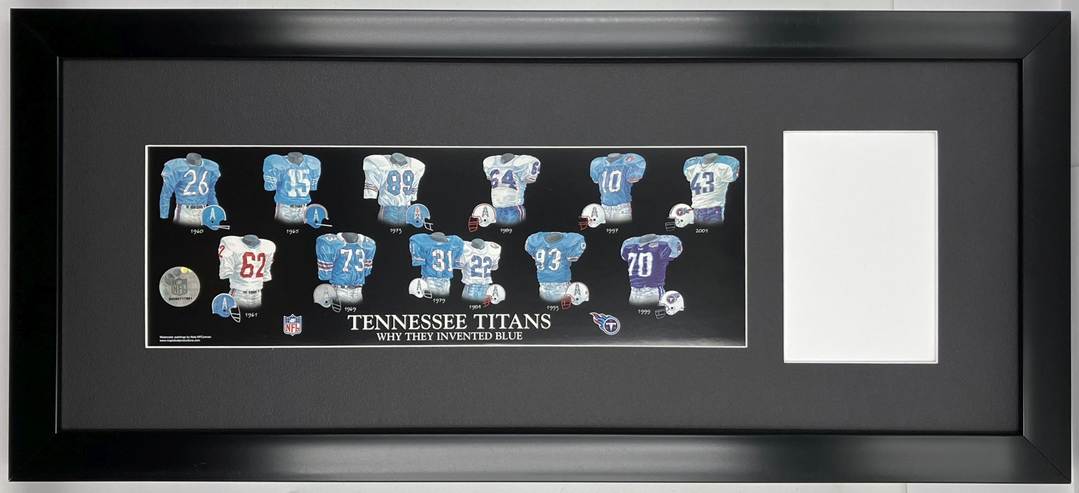
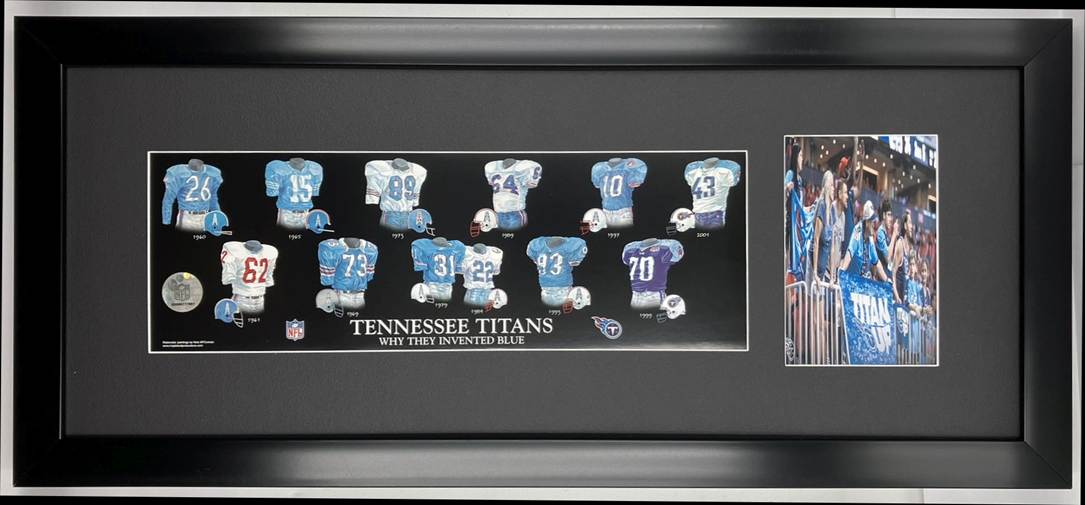
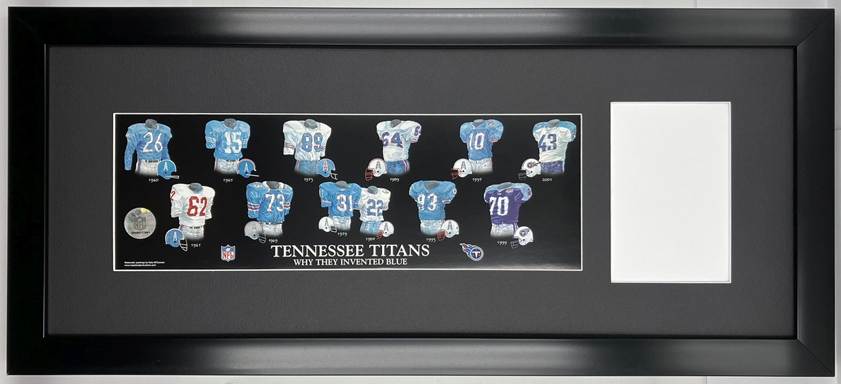
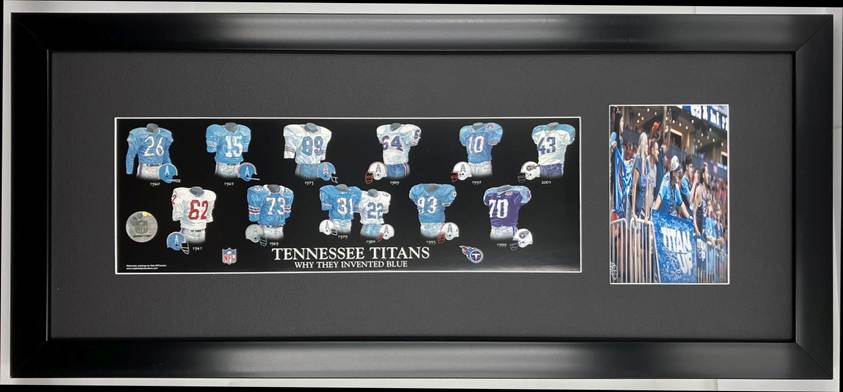
Framed Evolution History Tennessee Titians Uniform Print with Your Photo: Framed with our classic, smooth black frame
with glass cover, it measures 11 3/4 inches high x 26 1/4 inches long. The cost for this custom picture is only $79 and there is a one-time $6 discount shipping cost regardless of how many you
order!
Just
add your standard 4 inch x 6 inch photo – whether it’s you in your team jersey,
or team memorabilia or something very creative, your photo possibilities are
endless because you’re only limited by your imagination.
And
you can change your photo as many times as you like!
Here are the easy steps to add your photo:
1. Use a standard 6 inch x 4 inch
photo. Keep in mind the mat will slightly overlap the photo 1/8 inch
on all four sides.
2. Turn the framed picture on its
back and bend up all the flexible tabs used to secure the picture.
3. Remove the white backing.
4. Place your photo over the mat
opening. We have marked guide lines to help you position the photo
perfectly.
5. Secure your photo on all four
sides with strips of the quality Artist’s Tape we have provided.
6. Put back the white backing and
bend back a few of the flexible tabs.
7. Look at the picture to make
sure it looks great. Then bend back the rest of the flexible tabs to
secure your framed picture. You’re Done!
We will of course include a card listing the above
steps with your order. Keep in mind you can
change your
photo as many times as you like!
And if you ever need more tape, just email us and we’ll mail you more
tape at no charge. Our email is listed
on the card.
You can also view our
how-to-do video for our “Team Up With” personalized picture (This how-to-do
video applies to all our personalized framed pictures) here:
Or you can download
our how-to-do video.
Ordering Info:
Or
(You don’t pay Sales Tax when you order from our Shopping Page.)
Click here to return to List of Teams and
Leagues
***************************************
The Tennessee Titans: “Why They
Invented Blue”
The Greatest-Scapes is an
accredited business of the Better Business Bureau. We have been a member of the Better Business
Bureau since 1986—and we have an A+ rating.
For more detailed
information about The Greatest-Scapes, please click the BBB Logo at left.
Thank you

E-mail: greatestscapes@hotmail.com
Click here to return to List of Teams and
Leagues
***************************************
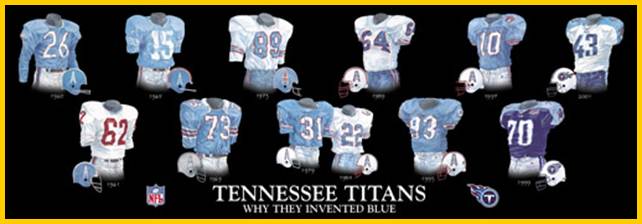
Here then is the history of the Titans’ Uniforms …
#1.
1960 Tennessee Oilers Owner/President K.S. "Bud" Adams Jr. was
one of the founding fathers of the AFL. Billy Cannon, the Heisman Trophy winner
from Louisiana State, was the Oilers's and the AFL's first big-name signing. In
1960 and 1961, Houston won back-to-back AFL titles. The Oilers almost won a
third straight title in 1962, but they lost a thrilling, double-overtime game
to the Dallas Texans, 20-17. At the time, it was the longest professional
football game ever played—77:54.
Originally located in Houston, the
team was known as the Oilers. After playing two seasons as the Tennessee
Oilers, team owner Bud Adams formed an advisory committee to research names. A
“Guess the Name” contest to gain additional feedback was held, and the
committee selected the name “Titans”, citing the desire to have a nickname that
reflected “strength, leadership and other heroic qualities.”
Among the many coaches who have
led the successful Oilers teams were Lou Rymkus, who guided them to their first
championship in 1960 and Wally Lemm, who coached the 1961 AFL title team.
In their first year of play, the
Oilers finish first overall with a 10-4 record, leading them to the AFL
Championship game. In front of 32,183 fans in Jeppesen Stadium, the Oilers win
an exciting game 24-16 over the Chargers.
This light blue jersey has white
player numbers on the front and on the sleeves, and as you can see they are
outlined in red. The white pants have red and blue vertical stripes. The helmet
has a white stripe along the top, and the logo of an Oil Rig is placed on the
side.
#2.
1961 Tennessee Oilers Owner/President K.S. "Bud" Adams Jr. was
one of the founding fathers of the AFL. Billy Cannon, the Heisman Trophy winner
from Louisiana State, was the Oilers's and the AFL's first big-name signing. In
1960 and 1961, Houston won back-to-back AFL titles. The Oilers almost won a
third straight title in 1962, but they lost a thrilling, double-overtime game
to the Dallas Texans, 20-17. At the time, it was the longest professional
football game ever played—77:54.
The fabled George Blanda, who
played 26 years and was the Oilers' quarterback from 1960 to 1966, would be the
first Titan to be inducted into the Football Hall of Fame in 1981.
Among the many coaches who have
led successful Oilers teams were Lou Rymkus, who guided them to their first
championship in 1960 and Wally Lemm, who coached the 1961 AFL title team.
After a 10-3-1 season, the Oilers
finish their season meeting the Chargers once again in the Championship game.
In front of 29,556 fans at Balboa Stadium, Houston wins with a final score of 10-3.
This jersey now has ¾ length
sleeves, and if you look closely, you will notice that the neckline is now
blue. Note the mask on the helmet. The helmet also has a logo of an oil rig on
the side.
#3.
1965 Houston started its AFL life in Jeppesen Stadium, a high school
facility that seated 33,000, before moving to 70,000-seat Rice Stadium in
1965.Unfortunately, the move didn’t help move them up in the standings, as the
Oilers finish with a 4-10 record.
Although the team didn’t put up
the numbers, some players did, and the Oilers were led offensively by QB George
Blanda, who passed for 2542 yards and 20 td’s. On the defensive side of things,
HB Ode Burrell rushed 528 yards.
This light blue jersey takes on a
bit of a change from previous years adding three white stripes on the arms,
removing the player numbers from the jersey, except on the front, and as you
can see, the numbers are no longer outlined. The helmet also takes on a change
as the mask changes along with the stripes. If you look closely, you will see
that the player numbers have been added to the back of the helmet.
#4.
1969 In 1968, the Oilers moved into the
nation's first domed stadium, the air-conditioned Astrodome, thus becoming the
first team in professional football to play indoors on synthetic turf.
The period of time between 1966
and 1969 warrants a bit of explanation. The 8 team AFL began in 1960 as a rival
league to the NFL - both leagues competed head to head for players, fans and TV
revenue. And thus it was for 5 years - two separate leagues, two separate
champions (although few people would have honestly believed that the AFL
champion could have beaten the NFL champs). Then in 1965 the two leagues agreed
to merge. It was decided that beginning in 1970 there would be only one league,
the NFL, and that between 1966 and 1969 the AFL Champion would play the NFL
Champion for the “World Championship”. It was only after the first World
Championship had been played in 1966 that the name “Super Bowl” came into
being.
Thus the 1966 season saw the first
meeting of the AFL and NFL champions, with the NFL Champion Green Bay Packers
humbling the AFL’s KC Chiefs 33-10. (Even though the game was played in 1967,
most football historians refer to this as the 1966 Super Bowl because it was
the culmination of the 1966 season.) The NFL superiority was on display again in
1967, when the NFL’s Packers pounded the AFL’s Raiders 33-14.
Then came 1968 and the stunning
upset - the AFL’s NY Jets shocked the football world by beating the NFL’s
heavily favored Baltimore Colts 16-7.
Thus the stage was set for the
Super Bowl IV, the last meeting between the AFL and NFL Champions.
Since the AFL/NFL merger in 1970,
Houston has reached the playoffs 10 times. Unfortunately, the AFL championships
the team won in the early 1960's are the only league titles the Oilers have
won.
After playing to a 6-6-2 season,
the Oilers would finish second, and during the AFL Inter-Divisional Playoff
Game played at Alameda County Coliseum, the Raiders defeated the Oilers 56 - 7
in front of 53,539 fans.
This blue jersey has added red
stripes to the arms, and have also added the player numbers to the shoulders of
the jersey. If you look closely, you will see that the vertical stripes on the
pants have also changed, making the blue stripe thicker and more pronounced.
You will see that we have added a picture of a neck guard, and that is because
most teams wore them for further protection when they get hit. Also, note the
change of the mask on the helmet. As well, the helmet is now grey, and the oil
rig is outlined with team colours.
#5.
1973 The Oilers fell into a slump, and
after two embarrassing seasons, head coach Bill Peterson was replaced with Sid
Gilman. The team went 1-18 in two seasons. They finish this year in 1-13,
hoping a brighter future is shortly ahead of them.
The team was led by QB Dan Pastorini
who passed for 1482 yards and 5 td’s. The defense was led by RB Fred Willis who
rushed 579 yards.
This white jersey has removed the
player numbers from the shoulders, and changed the red and blue stripes on the
arms. The helmet is blue, with the red and white stripes along the top. The
mask has changed, and if you look closely at the logo, you will see that the
background of the oil rig is coloured in.
#6A.
1979 Among the many coaches who have led
successful Oilers teams were Lou Rymkus, who guided them to their first
championship in 1960 and Wally Lemm, who coached the 1961 AFL title team.
"Bum" Phillips, who joined the team in 1975, led the Oilers to three
straight playoff appearances between 1979 and 1981.
The Oilers finish in second place this
season with a 11-5 record, and one again see themselves make it to the
playoffs. The first team to feel the wrath of the Oilers was Denver. In the AFC
Wild Card game, Houston defeated the Broncos 13-7 in front of 48,776 fans at
the Astrodome. They’re second victims would be the San Diego Chargers, whom
they played a close game with, winning 17-14 in front of 51,192 fans at San
Diego Stadium. The last game for the Oilers in this season would be the AFC
Championship Game played at Three Rivers Stadium, in front of 50,475 fans. The
Oilers would lose the game 27 - 13.
This light blue jersey adds the
player numbers to the sleeves above the red, blue and white stripes. The helmet
is once again white, and the logo of the oil rig is outlined. If you look closely,
you will see the change of the mask.
#6B.
1984 Since 1983, the Oilers have seen
three head coaches. Ed Bile resigned after six games, and was replaced by Chuck
Studley. Hugh Campbell took over coaching duties, and they finish this season
fourth overall, with a record of 2-14 on the season.
QB led the team with passing yards
and td’s.
This white jersey has the striped
moved to the edge of the arms. You will notice a patch on the left shoulder of
the jersey. This celebrates the AFL’s silver anniversary from 1960 to 1984. If
you look closely, you will see that mask has been changed, and the colour is
now red.
#7.
1989 Among the many coaches who have led
successful Oilers teams were Lou Rymkus, who guided them to their first
championship in 1960 and Wally Lemm, who coached the 1961 AFL title team.
"Bum" Phillips led the Oilers to three straight playoff appearances
between 1979 and 1981, and between 1986 and 1989, Jerry Glanville took the
Oilers to the postseason three times.
This season the Oilers finish with
9 wins and 7 losses, good for second overall. The Oilers see themselves playing
the Steelers in the AFC Wild Card Game, only to lose at home in front of 58,306
fans by a final score of 26-23.
This white jersey has player
numbers on the sleeves as well as the front. If you look closely, you will
notice the change of the mask on the helmet.
#8.
1993 Among the many coaches who have led
successful Oilers teams were Lou Rymkus, who guided them to their first
championship in 1960 and Wally Lemm, who coached the 1961 AFL title team.
"Bum" Phillips led the Oilers to three straight playoff appearances
between 1979 and 1981, and between 1986 and 1989, Jerry Glanville took the
Oilers to the postseason three times. In 1991 and 1993, Jack Pardee led Houston
to its first division titles since the late 1960's.
The Oilers have qualified for the
playoffs 15 times in the franchise's history. Since the AFL/NFL merger in 1970,
Houston has reached the playoffs 10 times. But the AFL championships this team
won in the early 1960's are the only league titles for the Oilers.
The Oilers finish atop their
division with a record of 12-4. In the AFC Wild Card Game, the Oilers find
themselves facing up against the Buffalo Bills at Rich Stadium in front of
75,141 fans. Unfortunately for the Oilers, their season ends as the Bills win
the game 41-38.
If you look closely at this
jersey, you will note a smaller patch the NFL shield on the
jersey’s neckline. Most NFL uniforms added the NFL logo patch to the neck and
upper left thigh of the pants beginning in 1991 - an exception being in 1994
when teams occasionally wore "throwback" uniforms celebrating the
NFL's 75th anniversary. If you look closely, you will see the changes to the
mask of the helmet. Also note the circle at the back of the helmet displaying
the player number.
#9.
1997 In 1997, the Oilers became the first
NFL team to call Tennessee home when the franchise relocated to the Volunteer
state. Two years later in 1999, the franchise retired the nickname Oilers and
became known as the Titans. The change seemed to bring good luck with it as the
Oilers went on to win the AFC Championship that year and earn a trip to Super
Bowl XXXIV.
Finishing the season in third
place with a record of 8-8, the Titans were led by QB Steve McNair who passed
2665 yards and 14 td’s.
If you look closely at this
jersey, you will note a smaller patch the NFL shield on the
jersey’s neckline. Most NFL uniforms added the NFL logo patch to the neck and
upper left thigh of the pants beginning in 1991 - an exception being in 1994
when teams occasionally wore "throwback" uniforms celebrating the
NFL's 75th anniversary.
The patch on the left shoulder celebrates the teams inaugural
season in Tennessee. The team colours stay the same, however you will notice
that the player numbers have been removed from the arms. Also note the change
of the mask.
#10.
1999 In 1997, the Oilers became the first
NFL team to call Tennessee home when the franchise relocated to the Volunteer
state. Two years later in 1999, the franchise retired the nickname Oilers and
became known as the Titans. The change seemed to bring good luck with it as the
Titans went on to win the AFC Championship that year and earn a trip to Super
Bowl XXXIV.
The Titans finish in second place with a 13-3 record, where they
would start the playoffs with a Wild Card Game against the Bills. In front of a
home crowd, the Titans win the game 22-16. Next on the agenda would be the
Divisional Championship, where they took on the Colts, winning 19-16. Their next
victims would be the Jaguars, who in front of their home crowd, were defeated
by the Titans by a score of 33-14. Unfortunately, the Titans could not muster
another win, as they lose to the Rams in Super Bowl XXXIV 23-16.
When the Oilers became the Tennessee
Titans in 1999, they then took on a new modern-day look that pleased the fans
of Tennessee. The team’s logo features the fire of the titans and exemplifies
the characteristics of power, strength, knowledge and excellence.
If you look closely at this
jersey, you will note a smaller patch the NFL shield on the
jersey’s neckline. Most NFL uniforms added the NFL logo patch to the neck and
upper left thigh of the pants beginning in 1991 - an exception being in 1994
when teams occasionally wore "throwback" uniforms celebrating the
NFL's 75th anniversary.
With the change of the name came a
change to the jerseys. The name Titans now appears just below the neckline, and
the new logo of a sword and shield is placed on the arms. The player numbers
are added to the shoulders, on this jersey in particular is a patch on the left
shoulder which celebrates the teams trip to Super Bowl XXXIV. Where the oil rig
once was is now replaced with the Titans logo. The three stars represent the
three states of Tennessee. If you look closely, you will see a different
facemask as well.
#11.
2001 Led by QB Steve McNair, who passed
3350 yards and 21 td’s, the newly names Titans finish the season in fourth
place with a 7-9 record.
If you look closely at this
jersey, you will note a smaller patch the NFL shield on the
jersey’s neckline. Most NFL uniforms added the NFL logo patch to the neck and
upper left thigh of the pants beginning in 1991 - an exception being in 1994
when teams occasionally wore "throwback" uniforms celebrating the
NFL's 75th anniversary.
With the change of the name came a
change to the jerseys. The name Titans now appears just below the neckline, and
the new logo of a sword and shield is placed on the arms. The player numbers
are added to the shoulders, on this jersey in particular is a patch on the left
shoulder which celebrates the teams trip to Super Bowl XXXIV. Where the oil rig
once was is now replaced with the Titans logo. The three stars represent the
three states of Tennessee. If you look closely, you will see a different
facemask. Also. If you could see the back of the helmet, you would see an
American flag honouring the heroes of the tragic events of September 11th,
2001.