Personalized!
A Powerful, Classy, and Creative way
to be joined at the hip with your favorite team
(And of course the uniforms print
will never go “out of Fashion” because a team’s uniforms are forever.)
You
can hang it, lean it, or let it lay flat.
Framed Version 3
Personalized
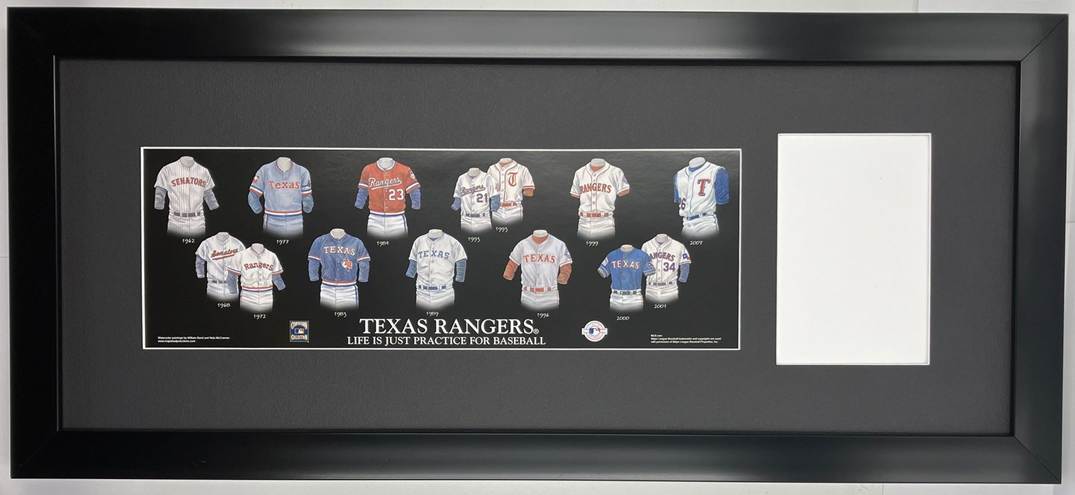
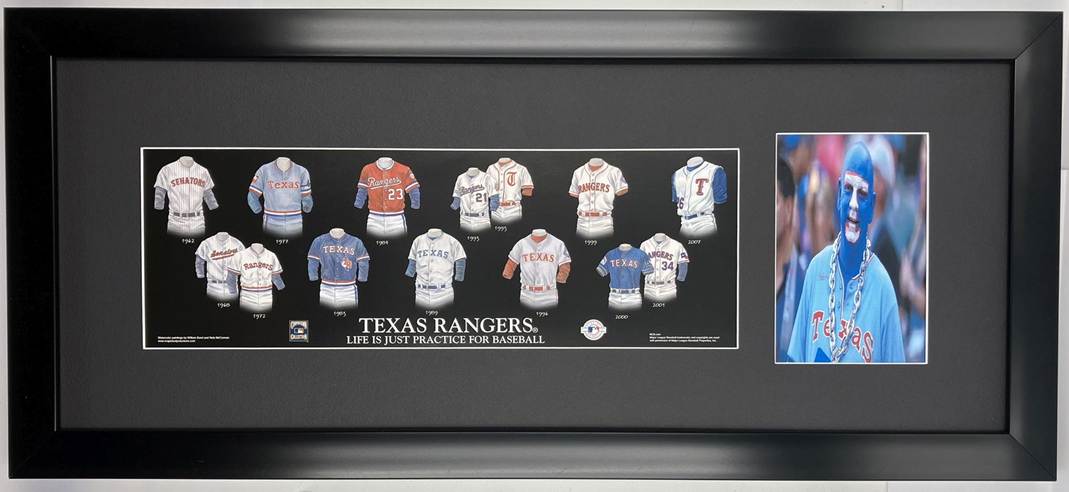
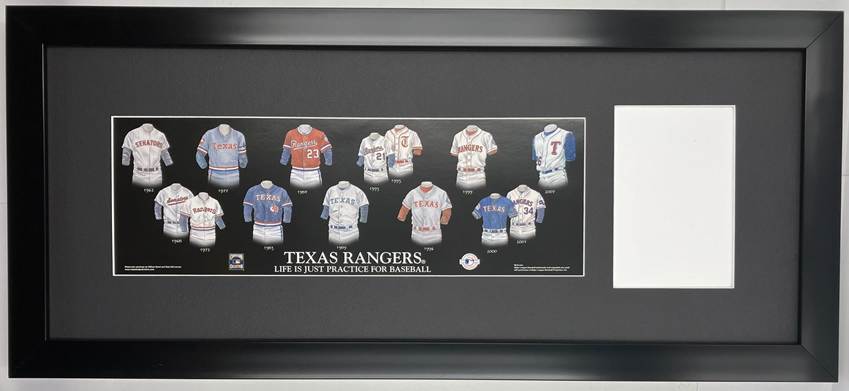
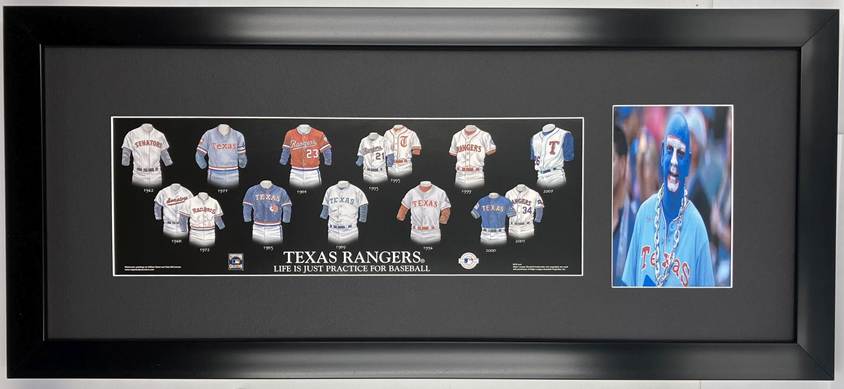
Framed Evolution History Texas Rangers Uniform Print with Your Photo: Framed with our classic, smooth black frame
with glass cover, it measures 11 3/4 inches high x 26 1/4 inches long. The cost for this custom picture is only $79 and there is a one-time $6 discount shipping cost regardless of how many you
order!
Just
add your standard 4 inch x 6 inch photo – whether it’s you in your team jersey,
or team memorabilia or something very creative, your photo possibilities are
endless because you’re only limited by your imagination.
And
you can change your photo as many times as you like!
Here are the easy steps to add your photo:
1. Use a standard 6 inch x 4 inch
photo. Keep in mind the mat will slightly overlap the photo 1/8 inch
on all four sides.
2. Turn the framed picture on its
back and bend up all the flexible tabs used to secure the picture.
3. Remove the white backing.
4. Place your photo over the mat
opening. We have marked guide lines to help you position the photo
perfectly.
5. Secure your photo on all four
sides with strips of the quality Artist’s Tape we have provided.
6. Put back the white backing and
bend back a few of the flexible tabs.
7. Look at the picture to make
sure it looks great. Then bend back the rest of the flexible tabs to
secure your framed picture. You’re Done!
We will of course include a card listing the above
steps with your order. Keep in mind you can
change your
photo as many times as you like!
And if you ever need more tape, just email us and we’ll mail you more
tape at no charge. Our email is listed
on the card.
You can also view our
how-to-do video for our “Team Up With” personalized picture (This how-to-do
video applies to all our personalized framed pictures) here:
Or you can download
our how-to-do video.
Ordering Info:
Or
(You don’t pay Sales Tax when you order from our Shopping Page.)
Click here to return to List of Teams and
Leagues
***************************************
The Texas Rangers: “Life Is Just
Practice For Baseball”
The Greatest-Scapes is an
accredited business of the Better Business Bureau. We have been a member of the Better Business
Bureau since 1986—and we have an A+ rating.
For more detailed
information about The Greatest-Scapes, please click the BBB Logo at left.
Thank you

E-mail: greatestscapes@hotmail.com
Click here to return to List of Teams and
Leagues
***************************************
Here then is the history of the Rangers’ Uniforms …
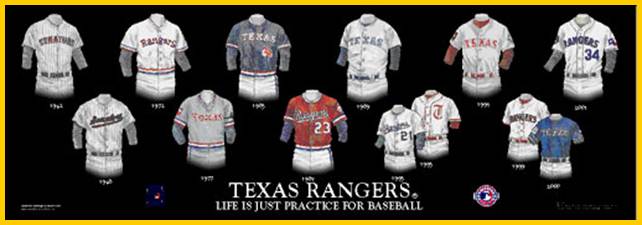
#1.
1962 The Texas Rangers began as the Washington Senators in 1961. This
was the second coming of the Senators as they originally started in the
American League as the Nationals in 1901. They changed the name to the Senators
in 1957. Then the team was relocated to Minnesota for the 1961 season, where
they became the Twins. The American League awarded an expansion franchise to
Washington once the original team left, so the “new” Senators club began in the
’61 season. In the new Senators season opener President John F. Kennedy threw
out the ceremonial first pitch in Griffith Stadium, (they only played here for
the first season). In 1962 the Senators move to their new home D.C. Stadium, (which
would later be renamed R.F.K. Memorial Stadium in 1969). In a year that
featured two All Star Games, (this was started in 1959, and ended this season)
D.C. Stadium played host to the first one and Chicago’s Wrigley Field was the
site of the second. The “new” Senators weren’t too successful this season,
finishing in last place in the AL with a 60-101 record.
The first uniform we see on the poster is a home jersey. The pinstripes were a
very classic look, but the zipper down the front gives it away as a ‘60’s
jersey. Several teams used the zipper as opposed to the buttons from the mid
‘40’s to the late ‘60’s. The Senators only used it on their home jerseys in the
’61 and ’62 seasons.
#2.
1968 As we see on this home uniform, the
Senators have stuck with the same look as we last saw in ’62, with the
exception of a few things. The lettering on the front is now in cursive
writing, complete with a “swoosh” that underlines the team name. Also, buttons
have replaced the zipper we saw on the last jersey.
The team hasn’t improved much since ’62. They finish this season in last place
yet again, going 65-96. The only major bright spot is the outstanding play of
Frank Howard, the Senators big hitting outfielder/first baseman. He led the
American League this season with 44 home runs, and finished second in RBI’s
with 106. In the winter of this year Robert E. Short buys majority interest in
the team while former Red Sox great Ted Williams joins the team as its Manager.
They finish with the franchises first winning season since they started in ’61,
garnering Williams the AL Manager of the Year Award.
#3.
1972 This Rangers home jersey is a
double-knit style that most major league teams succumbed to during the 70’s and
early 80’s. It was made of stretchy, synthetic material and the pants were
called “Sans-a-Belt” because the elasticized waistline that eliminated the need
for a belt. The team kept the Senators color scheme of red, white and blue.
Piping was added around the collar and sleeves, also with the red, white and blue.
At the end of the 1971 season,
owner Robert E. Short receives approval from the American League to move the
team to Arlington Texas for the next season, where they would play in Arlington
Stadium. They were renamed the Rangers, and went on to play a sub par season.
New city, same results. They finished in last place yet again. At the end of
the season, manager Ted Williams retired from baseball, and Whitey Herzog
replaced him at the helm. Herzog wouldn’t even last a season in Texas. He would
be let go in September and Billy Martin would take over. Keen observers might
note that in 1972 the Rangers only played 154 games instead of the usual 162 –
why? On March 30 1972, Marvin Miller, executive director of the Players'
Association, completes his canvass of players on the issue of a players’
strike. The vote comes in at 663 in favor of a strike, ten against, and two
abstentions. Thus on April 6, 1972, for the first time in history, the
major-league season fails to open due to a general player strike. The strike,
announced April 1, will erase 86 games from the major league schedule. The end
of the baseball strike is announced on April 13 with an abbreviated schedule to
start two days later. The Rangers finish with a 54-100 record.
#4.
1977 This road uniform is still the
double-knit style with the “Sans-a-Belt”. It is now a pullover, with only two
buttons at the top. The black armband and #4 on the left sleeve pays respect to
infielder Danny Thompson, who joined the Rangers in ’76, and passed away in
December of that year. The patch on the right sleeve was first worn in ’76 as a
bicentennial patch. It had on it the years 1776 and 1976. The team seemed to
like the patch and hung onto it for a few more years, but took off the
bicentennial dates.
The Rangers are now contenders. Despite going through four managers in one
season, they have a great season winning 94 and losing 68, to finish only 8
games behind Kansas City in the AL West standings.
#5.
1983 The Rangers still have the “Sans-a-Belt” on their road uniform, but
have gone back to the style of buttons down the front. This is a darker blue
than the last jersey we saw, and they have added a new logo on the front. It is
the shape of Texas with a baseball and a large “T.R.” on top of that. The
letters for “TEXAS” are now white as opposed to the red we have seen before.
Texas finishes the season leading the American League in fielding and ERA but
finish in third place in the AL West with 77 wins and 85 losses. On a record
setting night in Oakland, the Rangers score 12 runs in the 15th
inning, the most in a MLB extra inning. They won the game 16 to 4.
#6.
1984 A second road jersey is added to the Rangers uniform this season,
all red. The lettering on the front of the jersey has also been changed. The
letters now read “RANGERS” as opposed to “TEXAS”. This is the first time the
Rangers have done this since 1974. Also the Rangers lettering has been changed
to cursive writing with the addition of a “swoosh” underlining the team name.
This is the first time player's numbers would appear on the front of the
jersey. Uniform numbers first made their appearance on the front of a uniform
in 1952 - the Brooklyn Dodgers were the first team to wear uniform numbers on
the front of their jerseys. The Braves followed suit in 1953, and the Reds
joined in beginning in 1956. The 1916 Cleveland Indians actually wore a uniform
number on their sleeve, but it wasn’t until the ’52 Dodgers that the number
made it to the front.
The Rangers fall back into their old ways and finish last in the AL West, going
69-92. To make matters worse, the Texas fans bared witness to a perfect game at
Arlington Stadium, when Mike Witt of the California Angels pitched the gem on
September 30th.
#7.
1989 This Rangers gray road uniform first
appeared in 1986. The “TEXAS” across the front is blue and they have removed
the numbers on the front that we saw on the last uniform. Also there are no
more patches on the sleeves.
The Rangers finish the season with
an 83-79 record, after signing a 41-year-old free agent pitcher by the name of
Nolan Ryan in the off-season. When they signed him, the only question was, how
much could the “Ryan Express” have left? This season he would collect his major
league leading 5000th career strikeout. The following year he would
record his 6th no-hitter of his career and his 300th win.
Then in 1991, at the tender age of 44 he recorded his 7th no-hitter,
another major league record. I’d say it was a pretty good gamble for the
Rangers. Also this season, future President George W. Bush and investor Rusty
Rose, purchase controlling interest of the Rangers.
#8A & B.
1993 The Rangers wore a main home
uniform, the one on the left, where the jersey stayed in the same style as
1986, but added two patches on the sleeves. To honor the last season of Arlington
Stadium, the Rangers wore a patch on the left sleeve, while on the right sleeve
they wore the initials H.E.C. for former owner H. E. (Eddie) Chiles who passed
away. The uniform on the right is a throwback jersey the team wore on only a
handful of occasions. The question is what were they throwing back to? The
Texas Rangers never had a team during the early days of baseball, which is what
this jersey is in the style of. Don’t get us wrong, we like the jersey in its
old style “T” with red piping running around the collar and down the buttons,
with wider red trim around the sleeves. It’s a classic look.
This would be a year of finales for the Texas Rangers. After 22 years of
baseball at Arlington Stadium, this season would be its last. It would give way
to a new ballpark that was built in Arlington Stadium’s shadow. Future Hall of
Famer Nolan Ryan would retire this season after 27 years in the majors, and 5
seasons with the Rangers. He is the all time leader in strikeouts with 5,714
and would pitch his last game on September 12th on fittingly enough,
“Nolan Ryan Appreciation Day”. The team would finish out their season with an
86-76 record.
#9.
1994 The road uniform we see has a new
style of lettering for the “TEXAS” on the front. The Rangers have all but taken
away any blue in their uniforms, and gone with red, including the belt. We also
see a new patch on the left sleeve, which is a diamond shape and has a large
Texas star in the middle for the “Lone Star State”. The commemorative patch on
the right sleeve is in honor of the 125th year of professional
baseball. The patch has the Major League Baseball logo and “125th
Anniversary” on it, and celebrates the Cincinnati Red Stockings 1869 team that
was the first openly professional team and went 65-0 in a nationwide
barnstorming season.
In this, the year of professional baseball’s 125th Anniversary,
there would be no World Series for the first time in 90 years, when a player
lockout in August 1994 put an end to the season. The Rangers were sitting in
first place in the AL West, despite a 52-62 record. Oh what might have been…
What a shame.
The Rangers move into a new home this season, The Ballpark in Arlington. It is
a fantastic new facility that has taken the looks of several old ballparks and
made it into an original field that players love to call home. So much so that
on July 28th, Ranger pitcher Kenny Rogers throws a perfect game, the
first for the Ranger’s.
#10A.
1999 This is a home uniform that is very
similar to the last jersey we saw. The “RANGERS” lettering on the front is
consistent with the “TEXAS” on their road jersey. The only addition is the
piping around the collar and down the buttons.
Nolan Ryan is elected to the National Baseball Hall of Fame and announces that
he will wear a Texas Rangers ball cap on the plaque that will hang in the Hall,
becoming the first Ranger to do so. The Rangers end the regular season in first
place in the AL West with a record on
95-67; 8 games ahead of the Athletics. They take on the Yankees in the
Divisional Series, but fail to win a game against the eventual World Series
Champions.
#10B.
2000 This jersey is what is referred to
nowadays as a “3rd jersey”. A 3rd jersey is a concept
that became commonplace by the mid 90’s. Most 3rd jerseys are worn occasionally
at home as well as on the road, giving a team a third option as to what uniform
to wear. And of course, the addition of a third jersey adds to the options fans
can buy, thereby increasing apparel revenues and ultimately benefiting the
team. More recently, teams have begun adding 4th and even 5th
jerseys to their roster of uniform possibilities. The Rangers wore this blue 3rd
jersey for the first time this season. The “TEXAS” on the front was oddly
enough white, with a red outline. We see a new patch on the left sleeve, which
is the flag for the State of Texas. The patch on the right sleeve is in honor
of the team’s Western Division Championship for 1999.
After a trip to the post season the previous year, the Rangers go from first to
worst in the American League West finishing 71-91. In the off-season they make
an offer to 25-year-old free agent shortstop Alex Rodriguez that he could not
refuse. Several teams tried to “woo” Rodriguez, but in the end, Texas became
his new home. And what a home he could build on the salary they give him, $252
million for 10 years. This is the largest contract in baseball history to date.
#11.
2001 As we see on this home uniform, the
Rangers have gone back to the blue and white look, with only a hint of red in
the outline of the letters and numbers. This also marks the return of numbers
to the front of the jersey. The Texas flag still flies proudly on the left
sleeve, while a commemorative patch for the 100th anniversary of the
American League is displayed on the right sleeve.
Even with the addition of Alex
Rodriguez to the team, the high priced and highly touted Rangers finish last in
the AL West, going 73-89, a whopping 43 games behind Rodriguez’s former team
the Seattle Mariners. Rodriguez led the AL in home runs with 52, runs with 133
and total bases with 393.