Personalized!
A Powerful, Classy, and Creative way
to be joined at the hip with your favorite team
(And of course the uniforms print
will never go “out of Fashion” because a team’s uniforms are forever.)
You
can hang it, lean it, or let it lay flat.
Framed Version 3
Personalized
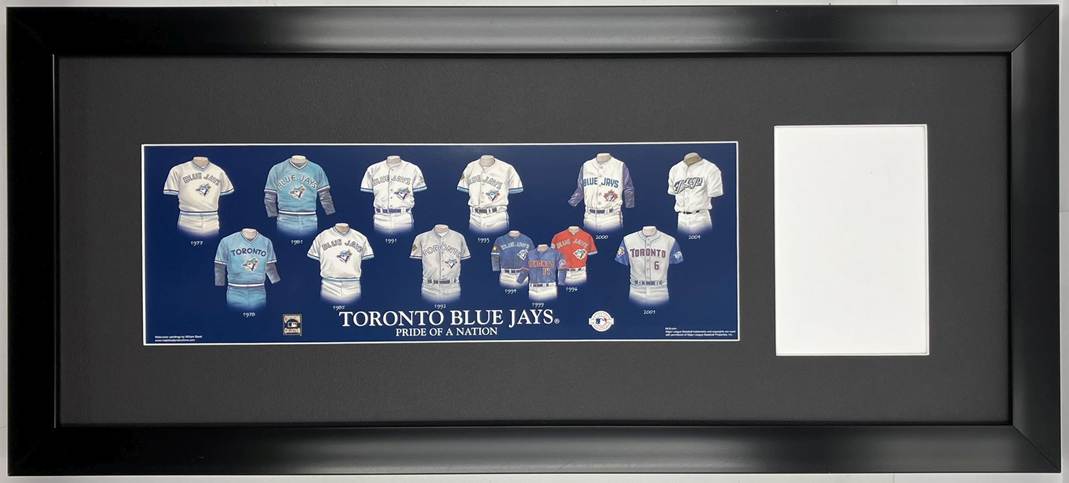
Framed Evolution History Toronto Blue Jays Uniform Print with Your Photo: Framed with our classic, smooth black frame
with glass cover, it measures 11 3/4 inches high x 26 1/4 inches long. The cost for this custom picture is only $79 and there is a one-time $6 discount shipping cost regardless of how many you
order!
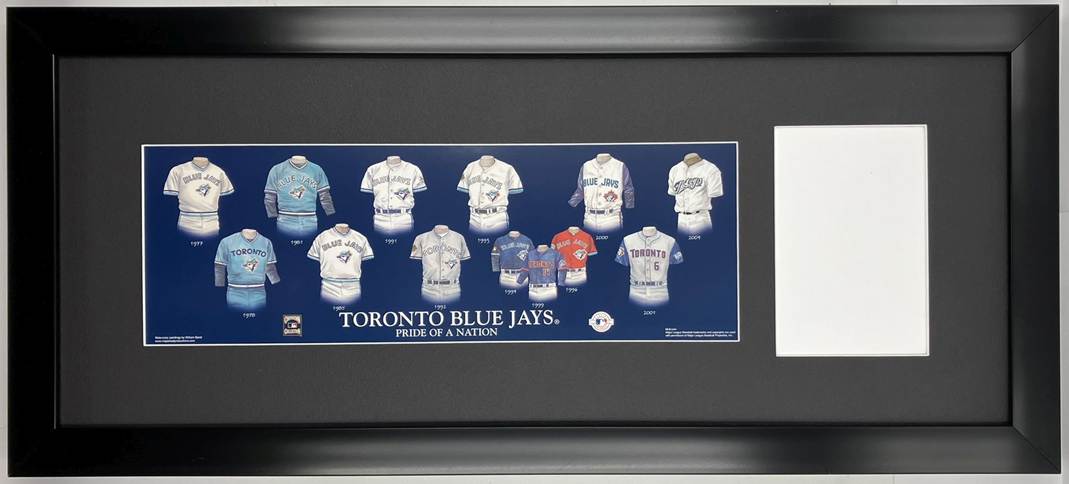
Just
add your standard 4 inch x 6 inch photo – whether it’s you in your team jersey,
or team memorabilia or something very creative, your photo possibilities are
endless because you’re only limited by your imagination.
And
you can change your photo as many times as you like!
Here are the easy steps to add your photo:
1. Use a standard 6 inch x 4 inch
photo. Keep in mind the mat will slightly overlap the photo 1/8 inch
on all four sides.
2. Turn the framed picture on its
back and bend up all the flexible tabs used to secure the picture.
3. Remove the white backing.
4. Place your photo over the mat
opening. We have marked guide lines to help you position the photo
perfectly.
5. Secure your photo on all four
sides with strips of the quality Artist’s Tape we have provided.
6. Put back the white backing and
bend back a few of the flexible tabs.
7. Look at the picture to make
sure it looks great. Then bend back the rest of the flexible tabs to
secure your framed picture. You’re Done!
We will of course include a card listing the above
steps with your order. Keep in mind you can
change your
photo as many times as you like!
And if you ever need more tape, just email us and we’ll mail you more
tape at no charge. Our email is listed
on the card.
You can also view our
how-to-do video for our “Team Up With” personalized picture (This how-to-do
video applies to all our personalized framed pictures) here:
Or you can download
our how-to-do video.
Ordering Info:
Or
(You don’t pay Sales Tax when you order from our Shopping Page.)
Click here to return to List of Teams and
Leagues
***************************************
The Toronto Blue Jays: “Pride Of A
Nation”

The Greatest-Scapes is an
accredited business of the Better Business Bureau. We have been a member of the Better Business
Bureau since 1986—and we have an A+ rating.
For more detailed
information about The Greatest-Scapes, please click the BBB Logo at left.
Thank you

E-mail: greatestscapes@hotmail.com
Click here to return to List of Teams and
Leagues
***************************************
Here then is the history of the Blue Jays’ Uniforms …
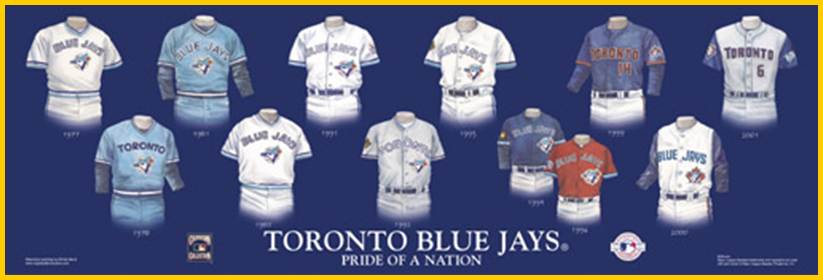
#1.
1977 The Toronto Blue Jays were almost the Giants. In 1976 the San
Francisco Giants almost moved to Toronto, until local buyers rescued the team
and kept them in San Francisco. Toronto was awarded a team in ’76 anyway, as
the American League expanded to 14 teams. The Jays first home opener on April 7th
1977 was a snowy affair against the Chicago White Sox. Even with snow covering
the field of Exhibition Stadium, the Jays took the opener 9-5. The Jays would
finish in last place in the American League East with a record of 54-107 this
season, (and for the next five seasons!).
The first home uniform for the Jays was a double-knit style that most major
league teams succumbed to during the 70’s and early 80’s. It was a pullover
style, made of stretchy, synthetic material. The pants were called
“Sans-a-Belt” because the elasticized waistline eliminated the need for a belt.
The “BLUE JAYS” lettering was unique to the Jays, and are the only team to use
it. The logo of the Blue Jay head was designed by a Toronto company, Savage
Sloan Ltd.
#2.
1978 This road uniform is almost the same
as the home uniform we saw the year before. The blue uniform had “TORONTO” in
dark blue on the front.
Adding Rico Carty and John Mayberry to the Jays lineup sure couldn’t hurt.
Mayberry hit 22 homers this season and Carty added 20 of his own. The Jays
still finished in last place with a record of 59-102, but the future looked
bright. Next season would see shortstop Alfredo Griffin win the Rookie of the
Year honors, (he shared the award with Minnesota Twins John Castino) the only
time a Blue Jay would win the award.
#3.
1981 As we see on this road uniform, the
Jays have switched from using “TORONTO” on their away jersey’s to “BLUE JAYS”,
which they would wear on both home and away uniforms. This is the first year
they would do this, and it would last until 1989.
In the year of the players strike, the season is split into two halves. It
didn’t help the Jays. They won only 37 times this season, losing 69 games, and
were 23½ games out of first. This was the first year that we would see an
All-Star Outfield with George Bell, Jesse Barfield and Lloyd Moseby. A winning
team was starting to come together.
#4.
1985 This home uniform is exactly the
same as their inaugural season, (thank goodness the team wasn’t) with the
double-knit pullover style, made of stretchy, synthetic material and the
“Sans-a-Belt” pants with the elasticized waistline for a belt. The “BLUE JAYS”
lettering on the front was still unique to the Jays and the blue jay head was
still right in the middle of the jersey.
After crawling out of last place for the first time in 1983, the Jays came in
second the following year. In 1985 they topped the Yankees by two games
finishing atop the American League East standings at 99-62. Pitcher Dave Stieb
led the AL in ERA at 2.48, as manager Bobby Cox led his team to 99 wins, and
was honored as Manager of the Year. They played George Brett and his Kansas
City Royals for the AL Pennant. The Jays went up 3 games to 1 in the series,
and were looking at their first pennant in team history. The Royals had other
plans. They came back to win the next three in a row, ending the Jays hopes of
a chance at the World Series in ‘85.
#5.
1991 The Jays finally made some changes
to their uniforms in 1989, as we see on this ’91 home uniform. They have lost
the pull over style in favor of a button down jersey with the Blue Jay logo to
the one side. They have also added a “real” belt and banished the elasticized
belt. The Jays hosted the All-Star game this year and showed this with the
patch on the left sleeve.
The Jays moved out of their cold and dreary old residence of Exhibition Stadium
in 1989, and into the modern day wonder called SkyDome. Their new home had a
retractable roof so there wouldn’t be any more “snow days” like the home opener
in ’77, yet the fans could still enjoy Toronto’s hot summer weather when the
dome was open. It had all the luxuries you could want at a ball game, including
a massive TV screen called the “Jumbotron”, a restaurant over looking center
field, and a hotel attached to the stadium with rooms that look onto the field.
The Jays had several new faces on the team this season including Joe Carter,
Roberto Alomar and Devon White, who all contributed in the team finishing in
first place in the AL East with a record of 91-71. They faced the Minnesota
Twins for the pennant, but fell to the eventual World Series Champs, 4 games to
1.
#6.
1992 The road jersey we see on this
championship uniform is the same as the year before, with the addition of the
World Series patch on the right sleeve. Teams began wearing these patches in
the World Series in the early 90’s.
Let the fun begin! They Jays make more additions to the team with ace pitchers
Jack Morris and David Cone, while adding the experience of Dave Winfield, and
the return of Alfredo Griffin. By the end of the season the Jays had won their
second straight AL East crown finishing 96-66, and went on to face the Oakland A’s
for the Pennant. Behind the play of Roberto Alomar, the Jays took their first
American League pennant 4 games to 2. The stage was now set for the first World
Series to be played outside America. The Atlanta Braves took the first game of
the series, but then Toronto took over. They won three straight to take a
stranglehold on the championship. After losing game five, the Jays came back in
game six with one thing in mind, victory. The Jays led 2-1 going into the
bottom of the 9th only to have the Braves tie it up, and send the
game to extra innings. In the top of the 11th, the Jays scored 2
runs to take the lead 4-2. In the bottom half of the inning the Braves scored a
run to come within 1, but with two out Atlanta’s Kenny Lofton tried to surprise
the Jays with a bunt. He was thrown out at first, giving the Toronto Blue Jays
its first World Series Championship and the first “North of the Border”.
#7.
1993 This home uniform hasn’t changed
much since the first time we saw it in 1991. They have a World Series patch on
the right sleeve as the team defended their championship this season.
After winning a World Series Championship, what can you do to top it? How about
winning two in a row! Once again the Jays added more talent to the line up,
most notably, ace pitcher Dave Stewart, clutch hitter Paul Molitor, and stolen
base record holder Rickey Henderson. For the third straight year the Jays took
the AL East over the Yankees, with a record of 95 wins and 67 losses. They
faced the Chicago White Sox for the pennant and took it for the second straight
year in six games. The Fall Classic awaited the Jays, with only the
Philadelphia Phillies standing in their way, (note: in 1944 & 1945 the
Phillies were actually called the Blue Jays). The blue birds went up 2 games to
1 in a high scoring Series so far. Game 4 would be no different. Going into the
8th, Philly was up 14-9. Closer Mitch Williams came into the game
looking to shut down any attempts at a Jay comeback. As the inning ended and
Williams walked back to the dugout, the Jays had scored 6 runs and win the game
15-14 and up 3 games to 1 in the Series. The next game saw the Phillies Curt
Schilling pitch a complete game 5 hit shutout, just what the Phillies needed.
Onto game six in Toronto. The Jays went up 5-1 early on, only to have the
Phillies score 5 of there own in the 7th to take the lead 6-5. Mitch
Williams comes on once again to close things out in the bottom of the 9th.
Rickey Henderson and Paul Molitor both get on base, as Joe Carter steps up to
the plate for one of the most memorable moments in World Series history. He
drives a Williams pitch to left for a dramatic three run homer, giving the Jays
their second straight championship. Carter’s home run is only the second Series
ending homer in history. Paul Molitor was named the Series MVP with a .500
batting average, 2 home runs, 2 doubles, 2 triples and 8 RBI.
#8A.
1994 The Blue Jays wore a couple of road
jerseys this season. The blue one we show here is the first all blue top we
have seen on the poster since the 1981 model, (thank goodness it isn’t the
light blue anymore!). The look is the same as previous years, with the addition
of the commemorative patch on the right sleeve in honor of the 125th
year of professional baseball. The patch has the Major League Baseball logo and
“125th Anniversary” on it, and celebrates the Cincinnati Red
Stockings 1869 team that was the first openly professional team and went 65-0
in a nationwide barnstorming season.
In this, the year of professional
baseball’s 125th Anniversary, there would be no World Series for the
first time in 90 years, when a player lockout in August 1994 put an end to the
season. The Jays were sitting in 3rd place in the AL East with a 55-60 record,
16 games back. In the National League the Jays Canadian counterparts, the
Montreal Expos were leading the Majors in wins, and some said this would be
their year for a championship. Oh what might have been… What a shame.
#8B.
1996 On July 1st, Canada Day,
the Jays began wearing this red jersey when they played a game at home. On the
back, the player’s names were taken off, and replaced with “CANADA”. The patch
on the right sleeve commemorates the 20th anniversary of the ball
club.
The team has its first Cy Young winner this season as Pat Hentgen is given the
award after going 20-10 for the season, while teammate Juan Guzman led the AL
in lowest ERA with 2.93. The blue birds start to rebuild the team after so many
years of winning. They finish this season in 4th place, 18 games out
of first with a record of 74-88.
#9.
1999 The new look Blue Jays. As we see on
this road uniform, changes were made in 1997, and first shown on the poster
this year. The logo is new, and has been moved from the front of the jersey to
the sleeve, as the player’s numbers are on the front for the first time.
Uniform numbers first made their appearance on the front of a uniform in 1952 -
the Brooklyn Dodgers were the first team to wear uniform numbers on the front
of their jersey. The Braves followed suit in 1953, and the Reds joined in beginning
in 1956. The 1916 Cleveland Indians actually wore a uniform number on their
sleeve, but it wasn’t until the ’52 Dodgers that the number made it to the
front. The lettering has been altered, and a red stripe has been added to the
dark blue and light blue stripes down the leg.
In the last year of the 90’s, a decade that began so well for the Jays, they
finally begin to have a competitive ball club once again. With the emergence of
heavy hitting Carlos Delgado, the Blue Jays stay in the hunt for a Wild Card
spot this season, until they hit a slump in August. They end up in third place,
behind the Yankees and Red Sox, with a record of 84-78.
#10.
2000 For the new millennium, the Jays
have made a change to their home jerseys. They have gone to the vest style,
which was made popular in the 60’s. The Blue Jay patch is now back on the front
of the jersey, replacing the player’s numbers, (this is only for the home
vest).
The Jays have another encouraging season, finishing in third place once again
with 83 wins and 79 losses, but only 4½ games behind the Yankees. David Wells
leads the Jays pitching staff with 20 wins, (tying him for the American League
lead). The blue birds sluggers keep on slugging, leading the AL in home runs
with 244.
#11.
2001 As we see on this road, vested
uniform, this is the first time the Jays have had a jersey where there is no
Blue Jay logo on the front or the sleeve. The only Blue Jay emblem we see is on
the patch on the left sleeve, which commemorates the Jays 25th
season. There are two Blue Jay logos on it, the original one from 1977, and the
new Blue Jay. Written on a banner at the bottom is; “A Summer Tradition Since
1977”. The patch on the right sleeve is for the celebration of the American
League’s 100th Season Anniversary.
The Jays hire a brand new manager
for the 2001 season in Buck Martinez, the Jays former catcher. Much was made of
Martinez’s move from the broadcast booth to the field without any coaching
history. With Martinez at the helm, the Jays finish third in the AL East, with
a 80-82 record, behind the Yankees and Red Sox. Toronto is led by Carlos
Delgado who hit 39 home runs and 102 RBI, while outfielder Jose Cruz Jr.
stepped up to hit 34 homers and drive in 88 RBI.